

You’re standing in the aisle, looking at two products. One is labeled “Epoxy,” and the other is “Epoxy Resin.” Are they the same thing? Is one better? This confusion is one of the most common stumbling blocks for DIYers, artists, and even engineers.
Let’s clear this up immediately: In everyday language, “epoxy” and “epoxy resin” refer to the same thing. “Epoxy” is simply the common shorthand for the two-part system known as epoxy resin.
The real confusion, and the question you should be asking, is: What is the difference between “resin” in general and “epoxy resin” specifically? Answering this question is the key to unlocking why epoxy is one of the most versatile and high-performance polymers in the world. This is not just a difference in names; it’s a fundamental difference in chemistry, performance, and application that every creator and manufacturer needs to understand.
The Great Misconception: “Resin” Isn’t One Single Thing
The biggest source of confusion stems from thinking of “resin” as a singular material. This is like asking for the difference between “metal” and “stainless steel.” One is a massive category, and the other is a specific, high-performance type within that category.
“Resin” is a broad term for a class of viscous, liquid polymers that can be hardened or “cured” into a solid state. This giant family includes many different chemical formulations, each with vastly different properties and uses:
- Polyester Resins: Often used with fiberglass to create boat hulls, car bodies, and surfboards. They are relatively inexpensive but can be brittle and have a very strong, distinct odor (styrene).
- Polyurethane Resins: Famous for their flexibility and abrasion resistance. You find them in foams (cushions, insulation), durable floor finishes, and flexible coatings.
- Silicone Resins: Known for their extreme temperature resistance and water-repellent properties. Used for creating flexible molds, sealants, and in high-temperature applications.
- Acrylic Resins: Valued for their clarity and UV stability. Plexiglas is a well-known example. They are also the basis for many paints and coatings.
- Epoxy Resins: The high-performance member of the family, renowned for superior adhesion, chemical resistance, and mechanical strength.

So, when you see a product just labeled “resin,” it’s crucial to know which type of resin it is. However, because of its popularity in the consumer market, “epoxy resin” has become the default people think of. From here on, we will focus exclusively on the chemistry that makes epoxy the go-to choice for so many demanding applications.
What Makes an Epoxy an “Epoxy”? The Two-Part Magic
Unlike some other resins that might cure with UV light or by evaporating a solvent, an epoxy system is defined by its two-part chemical reaction. It always consists of:
- Part A: The Resin (Epoxide Resin): This is the backbone of the system. At a molecular level, it’s a chain of molecules containing a special, highly reactive three-atom ring called an epoxide ring (one oxygen atom bonded to two carbon atoms). This ring is like a compressed spring, full of potential energy waiting to be released.
- Part B: The Hardener (Curing Agent): This is the catalyst that triggers the reaction. The most common hardeners are based on amines. When mixed with the resin, the amine molecules seek out and break open the tense epoxide rings.
This is where the magic happens. The process is called polymerization, or more specifically, cross-linking. As each epoxide ring is broken, it forms strong, permanent chemical bonds with the hardener molecules. This doesn’t just create longer chains; it creates a complex, three-dimensional, interlocking network of molecules.
This tightly cross-linked structure is the fundamental reason for epoxy’s famous properties:
- Incredible Strength & Adhesion: The dense, interconnected molecular web creates immense internal strength and allows the epoxy to form powerful chemical bonds with a huge range of materials (wood, metal, concrete, glass).
- Chemical & Water Resistance: The lack of gaps in the cured molecular structure makes it extremely difficult for water, solvents, or other chemicals to penetrate and break it down.
- Low Shrinkage: Because the curing process is an addition reaction (molecules joining together) rather than an evaporation reaction, epoxy shrinks very little as it cures. This ensures a tight fit and reduces stress on bonded parts.
- The Exothermic Reaction: The “compressed spring” of the epoxide ring releases its energy as heat when it breaks open. This is why you’ll feel a container of mixed epoxy get warm. This exothermic reaction is a sign that the curing process is working perfectly.
Not All Epoxies Are Created Equal: A Guide to the Epoxy Family
We’ve established that epoxy resin is a specific two-part system defined by its cross-linking chemistry. But the real genius of epoxy lies in its versatility. By subtly changing the molecular backbone of the resin (Part A), chemists can create a vast family of epoxies, each tuned for a specific set of performance characteristics.
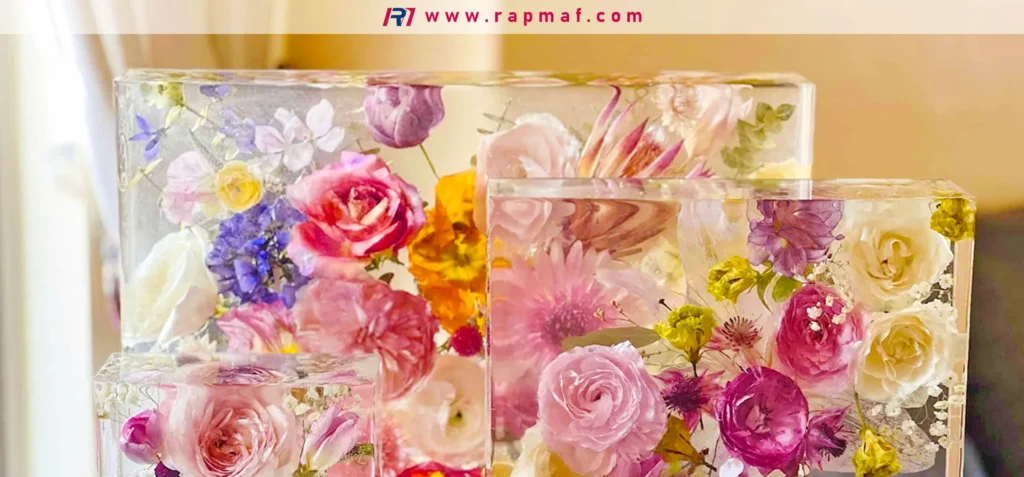
Choosing the right epoxy isn’t just about getting the mix ratio correct; it’s about matching the fundamental chemistry of the resin to the demands of your project. An epoxy that creates a flawless, glass-like coating on a piece of art would fail catastrophically as an industrial tank lining. Let’s explore the major players in the epoxy family.
1. Bisphenol-A (BPA) Epoxy Resin: The Workhorse
If you’ve bought a general-purpose, clear epoxy from a hardware store or an art supplier, you have almost certainly used a Bisphenol-A based epoxy. This is, by a massive margin, the most common and widely produced type of epoxy resin in the world.
- The Chemistry: It’s created by reacting Bisphenol-A with epichlorohydrin. This forms long molecular chains that are the foundation of its performance. Its liquid form is typically a clear, viscous fluid.
- Key Properties:
- Excellent Adhesion: BPA epoxy is the gold standard for bonding to a wide variety of substrates.
- Good Mechanical Strength: Once cured, it is a hard, rigid, and strong material with good compressive strength.
- Clarity and Gloss: It can be formulated to be exceptionally clear, which is why it’s the top choice for “art resin,” clear coatings, and “river tables.”
- Cost-Effective: Its widespread production makes it the most affordable epoxy type.
- Key Limitations:
- Poor UV Resistance: This is its Achilles’ heel. When exposed to direct sunlight over time, standard BPA epoxy will yellow and eventually become brittle. High-end art resins include UV inhibitors to slow this process, but they cannot stop it entirely.
- Moderate Chemical & Heat Resistance: While good, it can be attacked by aggressive solvents and begins to soften at relatively low temperatures (often around 80°C / 176°F).
- Common Applications: Bar top coatings, wood laminating, jewelry making, garage floor coatings (with UV-stable topcoats), general-purpose adhesives, and art projects.
2. Bisphenol-F (BPF) Epoxy Resin: The Fortified Version
BPF is the lesser-known but powerful sibling of BPA. Chemically, it’s very similar, but a tiny change in its molecular structure—replacing a central carbon atom with a simpler bridge—gives it a significant performance boost in specific areas.
- The Chemistry: It’s made by reacting Bisphenol-F with epichlorohydrin. The resulting molecule is less viscous (thinner) than BPA epoxy.
- Key Properties:
- Superior Chemical Resistance: BPF offers significantly better resistance to many solvents and chemicals compared to BPA.
- Higher Temperature Resistance: It can generally withstand higher service temperatures before softening.
- Low Viscosity: Its thinner consistency allows it to penetrate porous surfaces more effectively and release air bubbles more easily. It’s often blended with BPA resins to lower the overall viscosity of a formulation.
- Key Limitations:
- More Expensive: It is more costly to produce than BPA.
- More Brittle: When used alone, it can be more brittle than standard BPA epoxy.
- Common Applications: Industrial flooring in chemical plants, tank linings, high-performance coatings, and as a blending agent to improve the performance of BPA systems.
3. Novolac Epoxy Resin: The Armored Tank
When you need the absolute best in thermal and chemical resistance, you turn to Novolac epoxy. This is a high-performance, industrial-grade material that operates in a different league from consumer epoxies.
- The Chemistry: Instead of a simple two-point connection like BPA, Novolac resins have multiple epoxide rings branching off their main molecular backbone. This creates an incredibly dense and highly cross-linked structure when cured.
- Key Properties:
- Exceptional Chemical Resistance: Novolac epoxies can withstand prolonged exposure to highly corrosive chemicals like 98% sulfuric acid that would completely destroy other epoxies.
- Extreme Heat Resistance: They maintain their structural integrity at very high temperatures, some formulations exceeding 200°C / 392°F.
- Unmatched Durability: The dense cross-linking results in a very hard, abrasion-resistant surface.
- Key Limitations:
- Very High Viscosity: They are often thick like honey or even semi-solid, making them difficult to work with.
- Brittle: Their extreme hardness can also make them brittle if not formulated correctly.
- Expensive and Dark in Color: This is a premium product, and it is typically dark amber or brown, making it unsuitable for decorative applications.
- Common Applications: Chemical storage tank linings, acid-resistant flooring in processing plants, high-temperature adhesives, and protective coatings for pipes and industrial equipment.
Case Study from RM (Rapid Manufacturing): Choosing the Right Epoxy Under Pressure
A client in the aerospace sector came to us with a challenging problem. They had designed a custom sensor array that needed to be fully “potted” (encapsulated) to protect it from the harsh environment inside a fuel system testing rig.
The Challenge:
The potting compound needed to do three things perfectly:
- Adhere tenaciously to both the aluminum housing and the delicate electronic components.
- Withstand constant vibration and thermal cycling without cracking.
- Resist exposure to jet fuel and aggressive hydraulic fluids.
The Novice Mistake: A less experienced engineer might reach for a standard, off-the-shelf BPA epoxy. It has great adhesion (fulfilling requirement #1). However, its rigidity would cause it to develop micro-cracks under intense vibration, and its moderate chemical resistance would fail upon long-term exposure to jet fuel. The entire unit, worth tens of thousands of dollars, would fail.
The RM Expert Analysis:
Our materials engineers knew this was a multi-faceted problem.
- A Novolac epoxy would provide the ultimate chemical resistance (requirement #3), but it was far too rigid and brittle. The thermal cycling and vibration would shatter it.
- A flexible polyurethane resin could handle the vibration, but it lacked the chemical resistance and the high-strength adhesion needed.
- We needed a hybrid solution—a material that combined high-strength adhesion, excellent chemical resistance, and toughness (the ability to absorb energy and resist cracking).
The Solution: A Toughened, Amine-Cured Epoxy System
We selected a specialized, high-purity BPF-based epoxy resin for its superior chemical resistance over standard BPA. Crucially, we didn’t use a standard hardener. We formulated a custom curing agent using a blend of cycloaliphatic amines and a flexible polymer additive.
This custom system gave us the best of all worlds:
- The BPF resin provided the chemical shield against the jet fuel.
- The amine hardener created a strong, tightly cross-linked structure for superior adhesion.
- The flexible additive created microscopic, rubber-like domains within the cured epoxy. These domains act like tiny shock absorbers, allowing the entire compound to absorb vibration and thermal stress without cracking.
The Result: The potted sensor arrays passed all vibration and chemical immersion tests with zero failures. Our deep knowledge of how to select and formulate different epoxy systems—going far beyond a simple “Part A and Part B”—was the key to the project’s success.
The Other Half of the Equation: How Hardeners Define Epoxy’s Final Form
We have established that “epoxy” is a system, and we’ve explored the diverse family of resins (Part A) that form its foundation. However, the resin is merely potential energy. It’s the hardener (Part B), also known as the curing agent or activator, that unlocks this potential and dictates the final properties of the cured material.

Thinking of the hardener as just a “catalyst” is the most common and misleading mistake. A true catalyst participates in a reaction but is not consumed by it. An epoxy hardener is a co-reactant. It doesn’t just trigger the cure; its molecules actively link the epoxy resin molecules together, becoming a fundamental and permanent part of the final solid structure.
If the resin is the bricks, the hardener is the mortar. You can have the strongest bricks in the world, but with the wrong mortar, the wall will crumble. Changing the hardener can change an epoxy’s:
- Cure Time (Pot Life and Tack-Free Time): From 5 minutes to over 24 hours.
- Final Hardness (Shore D): From a rigid solid to a semi-flexible material.
- Clarity and Color Stability: Determining if it stays water-clear or ambers over time.
- Heat Resistance (HDT): The temperature at which it begins to soften.
- Toughness and Flexibility: Its ability to resist cracking under impact or bending.
Let’s explore the main families of hardeners to understand how professionals build the perfect epoxy system.
1. Amine-Based Hardeners: The Most Common Family
Amines are the workhorses of the epoxy world. They react readily with the epoxide rings on the resin molecules at room temperature, making them ideal for everything from consumer adhesives to professional floor coatings. But even within this family, there are critical distinctions.
- Aliphatic Amines:
- What They Are: These are the fast and furious hardeners. They have a simple, chain-like molecular structure that reacts very quickly.
- Pros: Very fast cure, even in thin films and at room temperature. They create a hard, strong, and chemically resistant final product.
- Cons: The rapid reaction is highly exothermic (generates a lot of heat), which can cause problems in thick pours. They are notorious for “amine blush,” a waxy surface film that can form in cool, humid conditions and must be washed off. They also have poor UV resistance, yellowing quickly in sunlight.
- Where You’ll Find Them: “5-Minute Epoxy” adhesives, industrial repair putties, and fast-setting concrete bonding agents.
- Cycloaliphatic Amines:
- What They Are: These are the “premium” version of amine hardeners. Their molecules are arranged in a stable ring structure, which gives them superior properties.
- Pros: Excellent clarity and color stability with very good UV resistance (they are the key to high-end, non-yellowing “art resins”). They have better chemical resistance than aliphatic amines and are far less prone to blushing.
- Cons: They are more expensive and generally have a slower cure time.
- Where You’ll Find Them: High-performance art and tabletop resins, premium garage floor topcoats, and any application where long-term clarity and gloss are essential.
2. Polyamide Hardeners: The Tough and Water-Resistant Choice
Polyamides are long, flexible molecules that offer a different set of benefits compared to the rigid structure formed by amines.
- What They Are: They are a reaction product of dimerized fatty acids and amines. This gives them a long, flexible molecular backbone.
- Pros: They impart excellent toughness, flexibility, and impact resistance to the cured epoxy. They also have outstanding water resistance and adhesion, even to damp surfaces. The cure rate is much slower and less sensitive to mix ratio errors.
- Cons: They create a much softer, less chemically resistant, and less heat-resistant product than amines. They are also typically dark amber in color, making them unsuitable for clear applications.
- Where You’ll Find Them: Marine coatings below the waterline (for their water resistance), primers for metal and concrete, and flexible adhesives where toughness is more important than hardness.
3. Anhydride Hardeners: The High-Temperature Champions
When you need an epoxy that can survive extreme heat, you leave room-temperature cure systems behind and enter the world of heat-cured anhydrides.
- What They Are: These are hardeners that require high temperatures (often 100-200°C / 212-392°F) for an extended period to initiate the cure.
- Pros: They create the most temperature-resistant epoxy systems, with some capable of continuous service above 200°C. They also provide superb chemical resistance and excellent electrical insulation properties. The pot life at room temperature is extremely long (days or even weeks), allowing for complex manufacturing processes.
- Cons: The need for a heat cure is a major limitation, requiring specialized ovens and equipment. The final cured product is often very hard and brittle.
- Where You’ll Find Them: Encapsulating high-performance electronics (potting), creating aerospace composite parts (like carbon fiber wings), and high-temperature structural adhesives.
The Final Decision Framework: How to Choose Your Epoxy System
Now, we can combine our knowledge of resins (Part A) and hardeners (Part B) into a powerful decision-making framework. To choose the right epoxy, answer these five questions about your project:
- What is my #1 visual requirement?
- Glass-like Clarity: You need a BPA-based resin with a Cycloaliphatic Amine hardener that includes UV inhibitors. Nothing else will do for a non-yellowing “river table” or art piece.
- What is the harshest chemical or temperature it will face?
- Extreme Heat/Acids: You absolutely must use a Novolac resin with a heat-cured Anhydride hardener. This is a non-negotiable for industrial tank linings or high-temp electronics.
- Will it face impact, vibration, or bending?
- Toughness is Key: You need flexibility. A standard epoxy system is too rigid. Choose a system with a Polyamide hardener or a specialized “toughened” amine system like the one in our RM case study.
- How much working time do I need?
- Need it Fast: A 5-minute adhesive uses an Aliphatic Amine hardener.
- Need Hours: A deep-pour casting resin for a table uses a slow-curing Cycloaliphatic Amine hardener to prevent overheating.
- What am I bonding to, and in what conditions?
- Damp Concrete or Oily Metal: A Polyamide hardener is your best bet for its excellent adhesion in less-than-ideal conditions.
Conclusion: Epoxy Isn’t a Product, It’s a System
The journey from a confused query—”What’s the difference between epoxy and resin?”—ends with a clear, powerful understanding. “Resin” is a broad class of polymers, while “epoxy resin” is a specific, high-performance type within that class.
But the most critical takeaway is that epoxy itself is not a single product. It is a customizable chemical system. By professionally selecting a resin (Part A) for its core properties and pairing it with a specific hardener (Part B) to fine-tune the reaction, engineers and manufacturers like us at RM (Rapid Manufacturing) can create materials perfectly tailored to the most demanding applications. From protecting priceless art to ensuring the reliability of aerospace components, understanding the complete epoxy system is the key to success.
Need help selecting the right high-performance material for your next project? The experts at RM live and breathe material science. Contact us today for a quote.
Frequently Asked Questions (FAQ)
1. Are epoxy and epoxy resin the same thing?
Yes. In common language, the terms are used interchangeably. “Epoxy” refers to the entire two-part system (Resin + Hardener), while “epoxy resin” technically refers to Part A, but is often used to describe the whole system as well. The key is that “epoxy” is a specific type of resin system.
2. Is epoxy resin toxic?
The components of epoxy resin before curing are sensitizers and irritants. You must wear nitrile gloves, eye protection, and work in a well-ventilated area to avoid skin contact and inhalation of fumes. However, once fully cured according to the manufacturer’s instructions, epoxy resin is chemically inert and non-toxic. Many epoxy systems are even certified “food safe” for contact with food after a full cure (typically 7 days).
3. What’s cheaper, epoxy or polyester resin?
Polyester resin (the kind often used for fiberglass boats) is generally cheaper than epoxy resin. However, epoxy offers far superior adhesion, strength, water resistance, and less shrinkage, making it the better choice for high-performance applications.
4. Can I use any hardener with any resin?
Absolutely not. Epoxy systems are formulated with precise chemistry and stoichiometry (the mix ratio). Using the wrong hardener, or even the wrong mix ratio, will result in a soft, sticky, or weak cure that will never reach its specified properties. Only ever use the specific hardener that is sold with the resin.
5. Which epoxy resin is the best?
There is no single “best” epoxy. The “best” epoxy is the one that is correctly matched to your project’s specific needs. The best for a crystal-clear table (BPA + Cycloaliphatic Amine) is the worst for a chemical tank lining (Novolac + Anhydride).
References
- Lee, H., & Neville, K. (1967). Handbook of Epoxy Resins. McGraw-Hill. (View on Google Books) (This is the foundational, comprehensive textbook on epoxy chemistry).
- West System Inc. (n.d.). Epoxy Chemistry. (View on West System’s Website) (A leading manufacturer’s excellent and accessible explanation of the different resin and hardener types).
- Flügge, W. (Ed.). (2013). Handbook of Engineering Mechanics. Springer Science & Business Media. (View on Springer) (Provides context for the mechanical properties—like strength and stiffness—that epoxy systems are designed to achieve).
Disclaimer
The information on this page is for informational purposes only. RM makes no representations or warranties, express or implied, as to the accuracy or completeness of this information. For any third-party services procured through the RM network, it is the buyer’s responsibility to specify and confirm performance parameters, tolerances, materials, and workmanship during the quotation process. For more detailed information, please do not hesitate to contact us.
RM: Your Precision Manufacturing Partner
RM is an industry leader in custom manufacturing solutions. With over 20 years of profound experience, we have become the trusted partner for more than 5,000 clients worldwide. We specialize in a comprehensive range of manufacturing services—including high-precision CNC machining, sheet metal fabrication, 3D printing, injection molding, and metal stamping—to provide you with a true one-stop-shop experience.
Our world-class facility is equipped with over 100 state-of-the-art 5-axis machining centers and operates in strict compliance with the ISO 9001:2015 quality management system. We are dedicated to providing solutions that blend speed, efficiency, and exceptional quality to customers in over 150 countries. From rapid prototyping to large-scale production, we promise delivery in as fast as 24 hours, helping you gain a competitive edge in the market. Choosing RM means selecting an efficient, reliable, and professional manufacturing ally.
Explore our capabilities today by visiting our website: www.rapmaf.com