



When choosing between anodized aluminum and stainless steel, especially for cookware, there is no single “better” material. The best choice depends entirely on your priorities, as they represent a classic engineering trade-off between heat conductivity, durability, weight, and cost.
Here’s the quick answer for those in a hurry:
- Choose Hard Anodized Aluminum if you prioritize fast, even heating and a lighter-weight pan. It excels at tasks requiring responsive temperature control.
- Choose Stainless Steel if you prioritize extreme durability, corrosion resistance, and the ability to use any type of utensil without fear. It is the workhorse material for a lifetime of use.
This simple answer, however, hides the fascinating science that makes these two metals behave so differently. To make a truly informed decision, you need to understand what they are at a molecular level and why one heats up in a flash while the other can survive decades of abuse. In this guide, we will break down the materials science behind each, put them in a head-to-head showdown, and help you choose the right material not just for your kitchen, but for any demanding application.
The Workhorse: What is Stainless Steel?
Stainless steel is not a single material but a large family of iron-based alloys. What makes them all “stainless” is the addition of a key ingredient: chromium, typically at a minimum of 10.5% by mass. This is not just a coating; the chromium is mixed in throughout the entire material.
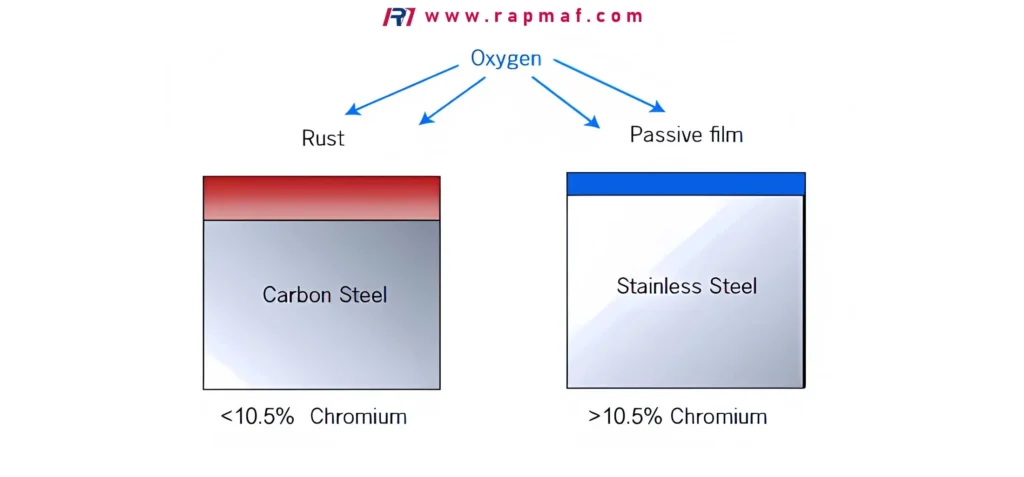
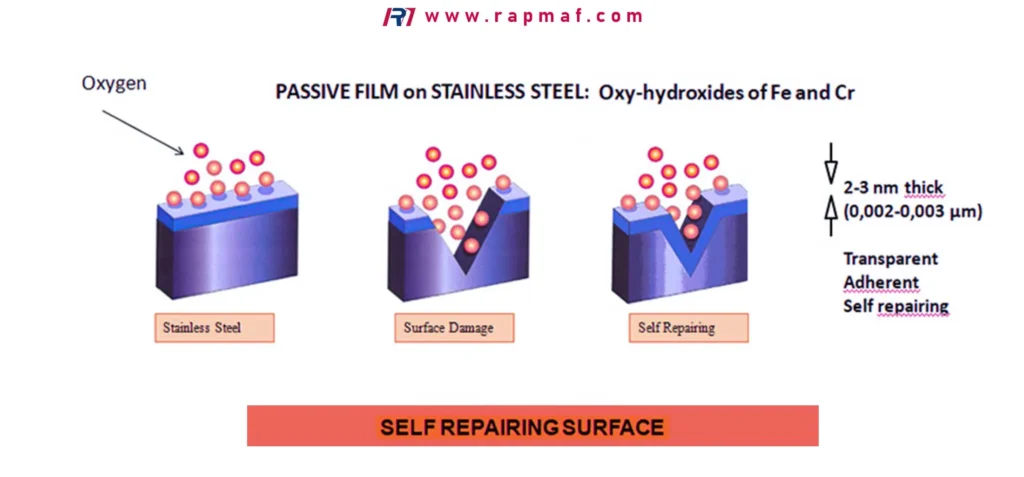
This chromium is the secret to stainless steel’s legendary reputation. When exposed to oxygen in the air, the chromium atoms at the surface of the steel form an incredibly thin, invisible, and chemically inert layer of chromium oxide. This is called a passive layer.
What makes this layer so remarkable is that it is self-healing. If you scratch a stainless steel pan, you are exposing new iron and chromium atoms to the air. Almost instantly, the newly exposed chromium reacts with oxygen and reforms the protective passive layer over the scratch. This is why stainless steel can resist rust, corrosion, and reactions with acidic foods like tomatoes or lemon juice.
Key Properties of Stainless Steel:
- Extreme Durability: It is a tough, dense, and strong material through-and-through. It resists dents, warping, and deep scratches.
- Superior Corrosion Resistance: Thanks to its self-healing passive layer, it’s highly resistant to rust and chemical attack.
- Non-Reactive: The passive layer prevents the metal from reacting with food, ensuring no metallic taste is imparted.
- Poor Heat Conductor: This is its biggest weakness in the kitchen. Iron is a relatively poor conductor of heat. This leads to “hot spots” directly over the burner, which can cause food to scorch in one area while being undercooked in another. To combat this, high-quality stainless steel cookware often has a core of a more conductive metal like aluminum or copper bonded into its base.
- Heavy: The density of steel makes it significantly heavier than aluminum.
The High-Performer: What is Anodized Aluminum?
Anodized aluminum starts as simple, lightweight aluminum. On its own, raw aluminum is an excellent heat conductor, but it’s also soft, easily scratched, and can react with acidic and alkaline foods. The process of anodization transforms this reactive, soft metal into a high-performance material.
Anodization is an electrochemical process. It is not a coating like paint or enamel. Instead of adding a layer on top, the process grows the natural oxide layer of the aluminum itself, making it dramatically thicker and harder.
Here’s a simplified breakdown of the process:
- A sheet of aluminum is submerged in an acid electrolyte bath (typically sulfuric acid).
- An electric current is passed through the bath, with the aluminum serving as the positive electrode (the anode).
- This forces the surface of the aluminum to oxidize in a highly controlled, structured way. The process builds a thick, perfectly integrated layer of aluminum oxide.
This new surface layer, aluminum oxide, is one of the hardest substances known to man, second only to diamond on the Mohs scale. Hard anodization is a more intense version of this process, using higher voltages and lower temperatures to create an even thicker and more durable layer.
Key Properties of Anodized Aluminum:
- Excellent Heat Conductor: The bulk of the material is still aluminum, so it heats up very quickly and distributes that heat evenly across the entire surface, eliminating hot spots.
- Hard, Scratch-Resistant Surface: The anodized layer is incredibly durable against everyday bumps and utensil use (though sharp metal utensils are still not recommended).
- Non-Reactive: Just like the chromium oxide on steel, the aluminum oxide layer is chemically inert and stable, creating a food-safe barrier that prevents the core aluminum from ever touching your food.
- Lightweight: It retains the low density of aluminum, making cookware and other products easy to handle.
We have now defined our two champions: the tough, self-healing workhorse and the lightweight, fast-heating high-performer. But how do they stack up in a direct comparison? In the next part, we will put them head-to-head on the criteria that matter most—from cooking performance to health and safety—and present a real-world case study from RM on how we choose between them for a demanding industrial application.
Head-to-Head: The Ultimate Showdown
In the first part, we defined our two materials: stainless steel, the durable, self-healing workhorse, and anodized aluminum, the lightweight, high-performance heat conductor. Now, let’s put them in a direct comparison across the six categories that matter most, from the kitchen to the workshop.
Heat Performance: The Sprinter vs. The Marathon Runner
This is the single biggest performance difference between the two materials.
Anodized Aluminum is the sprinter. Aluminum’s thermal conductivity is exceptionally high (around 235 W/mK). This means heat from a source spreads through it incredibly quickly and evenly. In a pan, this translates to heating up in seconds and eliminating hot spots, giving you precise temperature control. When you turn the heat down, the pan responds almost instantly.
Stainless Steel is the marathon runner. The iron base of steel is a relatively poor conductor of heat (around 15 W/mK for 304 stainless steel). It takes longer to heat up, and the heat doesn’t spread as evenly, creating hot spots directly over the flame. However, once it gets hot, its higher density allows it to retain that heat for longer. This is great for searing meat but less ideal for delicate sauces. This is why premium stainless steel cookware is almost always “clad” or has a “tri-ply” construction, sandwiching a thick layer of highly conductive aluminum or copper inside the less conductive steel.
- Winner: Anodized Aluminum (for speed and evenness)
Durability & Longevity: Brute Force vs. Engineered Hardness
Stainless Steel offers brute force durability. It is inherently strong, dense, and tough. It resists denting and is difficult to warp, even under high heat. While you can scratch the surface, it’s a cosmetic issue; the material’s properties run all the way through, and the scratch will self-heal its protective layer. A well-made stainless steel pan can literally last a lifetime and is often considered “buy it for life” equipment.
Anodized Aluminum offers engineered hardness. The strength of this material is concentrated in its incredibly hard surface layer. This aluminum oxide layer is more scratch-resistant than stainless steel. However, the core material is still softer aluminum. This means that while it resists surface scratches from utensils better, a sharp drop or heavy impact can still dent the pan. Furthermore, if the anodized layer is ever breached by a very deep gouge, the reactive aluminum underneath could be exposed.
- Winner: Stainless Steel (for lifetime toughness and warp resistance)
Health & Safety: Dispelling the Myths
This is a major point of confusion for consumers, so let’s be perfectly clear: Both hard anodized aluminum and stainless steel from reputable manufacturers are exceptionally safe for cooking and food contact.
The primary concern with aluminum is the myth linking it to health issues. However, extensive scientific research has found no causal link between aluminum exposure from cookware and these diseases. More importantly, in hard anodized cookware, the aluminum is not exposed. The cooking surface is aluminum oxide, which is a non-reactive, inert, and non-porous ceramic-like material. It is sealed and stable, and does not leach into food.
It’s also crucial to differentiate hard anodized from non-stick coatings. Hard anodized is NOT Teflon. It contains no PTFE, PFOA, or any other fluoropolymers. It is simply a thickened, hardened version of the metal’s own natural oxide layer.
The safety of stainless steel comes from its passive layer of chromium oxide. This layer is also incredibly stable and non-reactive, preventing the iron, nickel, or chromium in the alloy from leaching into food, except in trace, harmless amounts under very specific conditions (like simmering highly acidic foods for many hours in a brand new, unseasoned pan).
- Winner: Tie. Both are proven, safe materials.
The Head-to-Head Comparison Table
| Property | Hard Anodized Aluminum | Stainless Steel | The Bottom Line |
|---|---|---|---|
| Heat Conductivity | Excellent (Fast & Even) | Poor (Slow, Prone to Hot Spots) | Aluminum is far superior for responsive cooking. |
| Durability | Excellent surface hardness, but core is softer. | Excellent core strength and warp resistance. | Steel is the more resilient, lifetime material. |
| Corrosion Resistance | Very Good (Sealed Surface) | Excellent (Self-Healing Surface) | Steel has the edge due to its self-healing nature. |
| Weight | Lightweight | Heavy (Approx. 3x denser) | Aluminum is much easier to handle. |
| Safety (Food Contact) | Excellent (Inert Oxide Surface) | Excellent (Inert Passive Layer) | Both are exceptionally safe. |
| Utensil Use | Wood, silicone, nylon recommended. Metal can scratch. | All utensils, including metal, are safe to use. | Steel is more forgiving of rough use. |
| Cost | Generally more affordable. | Generally more expensive, especially for clad versions. | Anodized aluminum offers better performance for the price. |
Beyond the Kitchen: A Real-World Engineering Case Study from RM
While cookware is a great example, the choice between these materials is a daily decision in high-stakes engineering. At RM, we were tasked with designing a custom enclosure for an industrial power controller.
The Challenge
The controller needed to be mounted on a vibrating, mobile piece of factory equipment. The enclosure had to achieve four conflicting goals:
- Act as a heatsink: The internal electronics generated significant heat that had to be dissipated without a fan.
- Be durable: It needed to withstand bumps, scrapes, and exposure to corrosive cleaning agents.
- Be lightweight: The added weight on the machine’s robotic arm needed to be minimized.
- Be electrically insulating: The outer surface could not be electrically conductive.
The Contenders
- Stainless Steel (304): Our first thought for durability. It would easily resist corrosion and physical abuse. However, its poor thermal conductivity meant it would act like an oven, trapping heat and causing the electronics to fail. It was also very heavy.
- Hard Anodized Aluminum (6061-T6): Our second option. The base aluminum is an excellent thermal conductor, perfect for a heatsink. The anodization process would create a hard, scratch-resistant surface (much tougher than paint) and, critically, the aluminum oxide layer is an excellent electrical insulator. It was also one-third the weight of the steel design.
The Engineering Decision
The choice was clear. We selected hard anodized aluminum. It was the only material that could satisfy all four requirements. The stainless steel option would have been a catastrophic failure due to overheating. We designed the enclosure with integrated cooling fins, CNC machined from a solid block of aluminum, and then sent it for Type III (hard coat) black anodization.
The Result
The final part was a masterpiece of material selection. It was lightweight, incredibly tough, dissipated all the heat effectively, and provided the necessary electrical safety. It proves that “better” is always about the specific engineering demands of the application.
We’ve now compared these materials in detail and seen a real-world example. But the world of materials is never simple. In the final part, we will explore the different types of stainless steel (like 304 vs. 316) and provide a final decision-making framework to help you choose with confidence.
Beyond the Basics: Not All Steel is Created Equal
In the previous section, we established a clear winner’s circle: anodized aluminum for thermal performance and low weight, and stainless steel for brute-force durability and corrosion resistance. But to make a truly informed decision, especially in engineering or high-end cookware, we need to acknowledge that “stainless steel” isn’t a single material. It’s a vast family, and the specific alloy makes a world of difference.
Let’s look at three common examples to see how a few small changes in chemistry can radically alter performance.
The Workhorse: 304 Stainless Steel
When someone says “stainless steel,” they are most likely talking about Grade 304. It’s the most common and versatile type, making up over 50% of all stainless steel produced. You’ll often see it referred to as “18/8” stainless steel.
- The Chemistry: Its key ingredients are approximately 18% chromium and 8% nickel. The chromium creates the all-important passive layer that resists rust and corrosion. The nickel stabilizes the austenitic crystal structure (a specific atomic arrangement), which makes the steel non-magnetic and highly formable.
- Key Properties: Good corrosion resistance in most environments, excellent formability, and good weldability. It’s the perfect general-purpose choice.
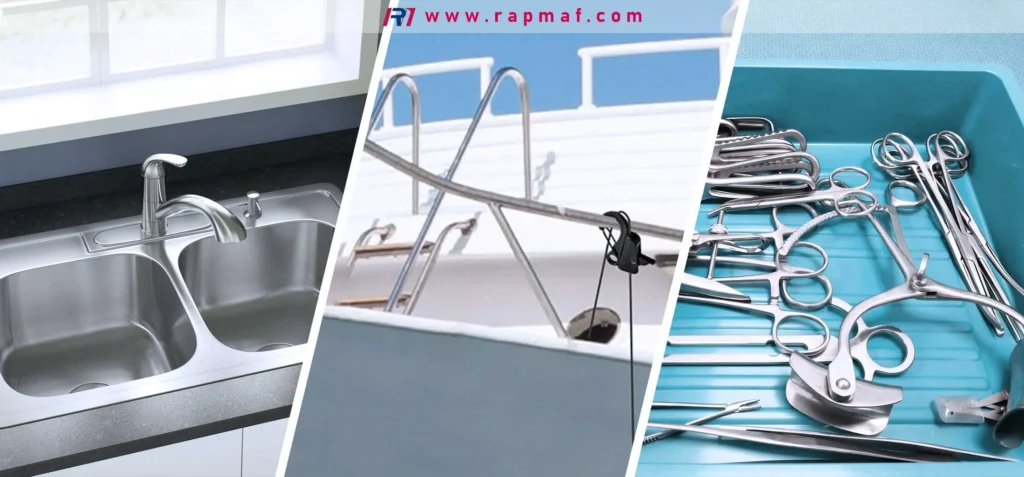
- Where You Find It: Cookware, kitchen sinks, food processing equipment, architectural paneling, and general industrial hardware.
- The Limitation: While good, its corrosion resistance isn’t absolute. It can be susceptible to pitting and corrosion when exposed to chlorides, such as salt water or de-icing salts.
The Marine Grade: 316 Stainless Steel
For applications where corrosion is a critical point of failure, engineers upgrade to Grade 316. It looks and feels nearly identical to 304, but it has a secret weapon.
- The Chemistry: 316 is very similar to 304, but with one crucial addition: molybdenum (typically 2-3%).
- Key Properties: The molybdenum significantly enhances corrosion resistance, especially against chlorides and other industrial chemicals. It provides a much more robust and stable passive layer that can withstand harsh environments.
- Where You Find It: Marine hardware (boat railings, cleats), chemical processing tanks, pharmaceutical equipment, and medical implants. If it’s going near the ocean or inside the human body, it’s likely 316.
- The Trade-off: This superior performance comes at a higher price tag, typically 25-30% more expensive than 304.
The Blade Master: 440C Stainless Steel
Both 304 and 316 are in the “austenitic” family. But there’s another major class called “martensitic” stainless steels, and 440C is a prime example.
- The Chemistry: This grade has a much higher carbon content and lower chromium compared to the 300 series.
- Key Properties: Its defining characteristic is that it is hardenable. Through a heat-treatment process (quenching and tempering), 440C can become incredibly hard and wear-resistant. This allows it to hold a razor-sharp edge. The trade-off is that it has lower corrosion resistance than 304 or 316.
- Where You Find It: High-quality knife blades, surgical instruments, ball bearings, and valve seats—any application where hardness and edge retention are more important than maximum corrosion resistance.
This brief overview shows that the choice is rarely just “steel.” It’s about selecting the right grade of steel for the job.
The Final Verdict: Your Decision-Making Framework
So, after exploring the science, manufacturing, and different grades, how do you make the final choice? It comes down to prioritizing your needs.
Choose Hard Anodized Aluminum When…
- Heat performance is your #1 priority. For cookware, this means fast, even heating and precise temperature control. For engineering, it means it’s the superior choice for heatsinks and thermal management.
- Weight is a critical factor. In aerospace, automotive, and even handheld applications, aluminum’s low density is a massive advantage.
- You need electrical insulation. The anodized surface is a non-conductor, making it ideal for electronics enclosures.
- Cost is a major consideration. Pound for pound and feature for feature, anodized aluminum products often provide better performance for the price.
Choose Stainless Steel When…
- Lifetime durability is the goal. For “buy it for life” cookware or industrial equipment in high-abuse environments, steel’s core strength and warp resistance are unmatched.
- Maximum corrosion resistance is non-negotiable. For marine, chemical, or medical applications, Grade 316 stainless steel is the gold standard.
- The product will be exposed to extreme heat. Steel’s much higher melting point makes it suitable for high-temperature applications where aluminum would fail.
- Ease of maintenance is key. The ability to use any utensil, including metal, and its general toughness make stainless steel incredibly forgiving.
Conclusion: Beyond “Better” to “Better For…”
The question “Which is better, stainless steel or anodized aluminum?” has no simple answer because it’s the wrong question. It’s like asking if a sprinter is a better athlete than a marathon runner. The answer depends entirely on the race.

Anodized aluminum is the sprinter: lightweight, fast, and a high-performance specialist in heat transfer. Stainless steel is the marathon runner: incredibly tough, endlessly durable, and able to endure the harshest conditions.
Understanding the fundamental properties we’ve discussed—thermal conductivity, hardness, corrosion resistance, and density—is the key to moving beyond marketing claims and making an informed decision. Whether you are choosing a skillet for your kitchen or designing a critical component for a satellite, the principles are the same. The best choice is never the material that is simply “better,” but the one that is engineered to be better for the task at hand.
Frequently Asked Questions (FAQ)
Is hard anodized aluminum healthier than stainless steel?
Both materials are considered exceptionally safe for food contact by regulatory bodies worldwide, including the FDA. The primary concern with aluminum is a myth, and in hard anodized cookware, the surface is a non-reactive, sealed layer of aluminum oxide. Neither material leaches harmful substances into food under normal use.
Can you use metal utensils on hard anodized cookware?
It is generally not recommended. While the anodized surface is harder than stainless steel, it is still a relatively thin layer. A sharp metal utensil could potentially scratch or gouge this layer, exposing the raw aluminum underneath. Wood, silicone, or nylon utensils are the safest choice.
Why is stainless steel cookware so much heavier?
This is due to a fundamental difference in density. The density of stainless steel is approximately 8 g/cm³, while aluminum is only about 2.7 g/cm³. This means for the same size pan, the stainless steel version will be nearly three times heavier.
Is anodized aluminum a non-stick surface like Teflon?
No, and this is a critical distinction. Hard anodized cookware is not coated with any chemical. The surface is created by electrochemically altering the aluminum itself. While a well-seasoned anodized pan can have some minor non-stick properties, it is not a true non-stick surface and does not contain any PTFE or PFOA.
What does “18/8” or “18/10” stainless steel mean?
This is a shorthand for the percentage of chromium and nickel in the alloy, respectively. “18/8” steel contains 18% chromium and 8% nickel (this is Grade 304). “18/10” is very similar but with 10% nickel, which can slightly improve its corrosion resistance and give it a brighter polish. Both are high-quality austenitic stainless steels.
References
- ASM International, Properties and Selection: Irons, Steels, and High-Performance Alloys (A comprehensive handbook detailing the properties of different stainless steel grades like 304, 316, and 440C).
- The Aluminum Anodizers Council, Military Specification MIL-A-8625 (The definitive US military standard that defines the types and quality requirements for anodizing, including Type III hardcoat).
- Callister, W. D., & Rethwisch, D. G. (2018). Materials Science and Engineering: An Introduction (A foundational textbook explaining the principles of thermal conductivity, corrosion, and material density).
Disclaimer
The information on this page is for informational purposes only. RM makes no representations or warranties, express or implied, as to the accuracy or completeness of this information. For any third-party services procured through the RM network, it is the buyer’s responsibility to specify and confirm performance parameters, tolerances, materials, and workmanship during the quotation process. For more detailed information, please do not hesitate to contact us.
RM: Your Precision Manufacturing Partner
RM is an industry leader in custom manufacturing solutions. With over 20 years of profound experience, we have become the trusted partner for more than 5,000 clients worldwide. We specialize in a comprehensive range of manufacturing services—including high-precision CNC machining, sheet metal fabrication, 3D printing, injection molding, and metal stamping—to provide you with a true one-stop-shop experience.
Our world-class facility is equipped with over 100 state-of-the-art 5-axis machining centers and operates in strict compliance with the ISO 9001:2015 quality management system. We are dedicated to providing solutions that blend speed, efficiency, and exceptional quality to customers in over 150 countries. From rapid prototyping to large-scale production, we promise delivery in as fast as 24 hours, helping you gain a competitive edge in the market. Choosing RM means selecting an efficient, reliable, and professional manufacturing ally.
Explore our capabilities today by visiting our website: www.rapmaf.com







10 Responses