



Hey everyone, Clive here, lead engineer at RM (Rapid Manufacturing). I’ve spent countless hours with our Powder Bed Fusion machines, watching impossibly complex metal parts grow from nothing but a fine grey powder. And I can tell you one thing for sure: the way a metal 3D printer works is nothing like the little desktop plastic printer you might have at home.
People often imagine a nozzle squirting out molten metal like a hot glue gun. The reality is far more precise, more complex, and frankly, more incredible. It’s a process that involves high-powered lasers or electron beams, inert gas chambers, and a level of control that feels like something out of science fiction.
In this guide, I’m going to pull back the curtain. We’re going to skip the marketing fluff and get right into the engineering principles, the step-by-step process, and the real-world applications of this transformative technology.
Quick Answer: How Does a Metal 3D Printer Work?
For those in a hurry, here’s the core concept in under 60 seconds. The vast majority of industrial metal 3D printers work using a process called Powder Bed Fusion (PBF).
- The Setup: A build chamber is filled with an inert gas (like argon or nitrogen) to prevent the metal powder from oxidizing (rusting or burning).
- The Process: A super-thin layer of fine metal powder (e.g., aluminum, titanium, stainless steel) is spread across a build plate.
- The Magic: A high-powered laser or electron beam then precisely scans the 2D cross-section of the part, melting or sintering the powder particles together to form a solid layer.
- The Repetition: The build plate lowers slightly, another layer of powder is spread on top, and the process repeats thousands of times, fusing each new layer to the one below it.
- The Result: A solid, fully dense metal part emerges from the bed of unfused powder.
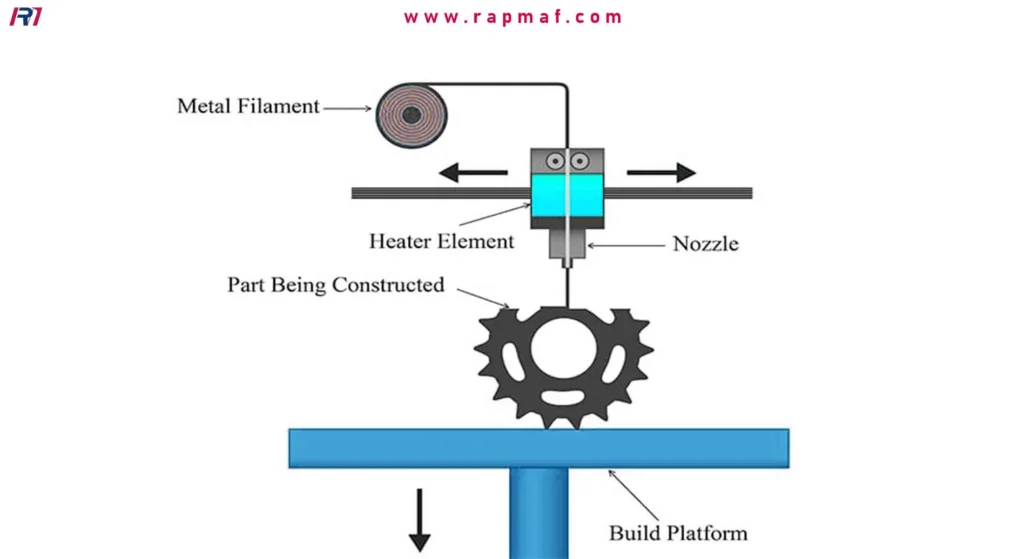
Think of it less like printing and more like a CT scanner running in reverse, building something solid from thousands of digital slices.
Who Am I, and Why Trust RM on This?
At RM, we aren’t just writers; we are a full-service manufacturing facility. Our credibility comes from the thousands of hours our team has spent operating, maintaining, and optimizing our own suite of industrial metal 3D printers. We’ve invested heavily in Direct Metal Laser Sintering (DMLS) technology because we’ve seen firsthand how it can solve problems that are simply impossible for traditional methods like CNC machining. We’ve pushed the boundaries on materials from 316L Stainless Steel to Inconel 718, and we’ve learned the hard lessons about what works and what doesn’t. The insights in this guide are born from the hum of our machines and the real-world challenges we solve for our clients every day.
The Core Principle: It’s Not Melting, It’s Fusion
The first thing to understand is the core physics. We’re not just melting metal into a puddle. The energy source—usually a laser—is so concentrated and moves so quickly that it creates a tiny, localized “weld pool.” This pool melts the new layer of powder and fuses it directly to the solid layer beneath it.
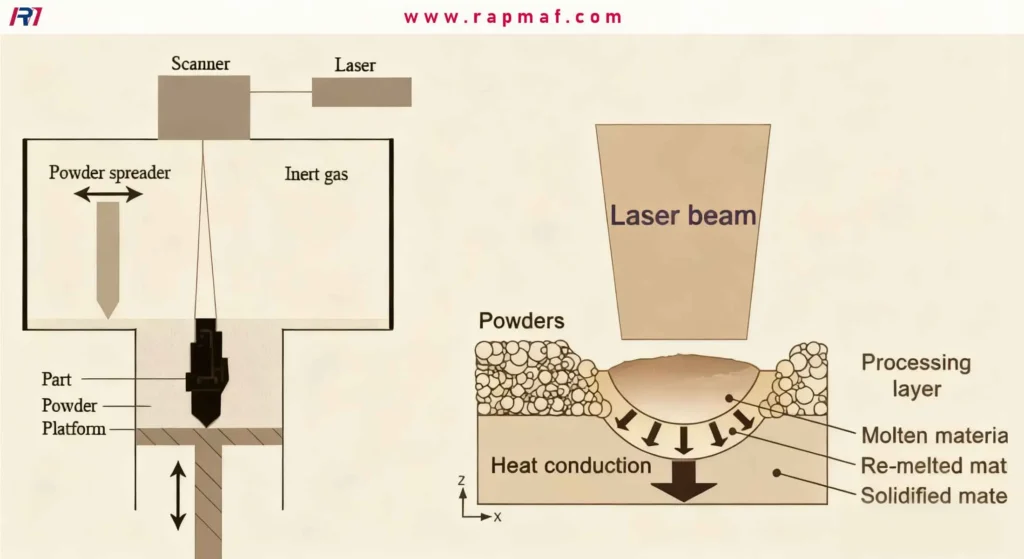
This process of joining particles together with heat is broadly called sintering. Imagine you have a cup of sugar. If you lightly heat it, the crystals on the surface will just start to get sticky and fuse together. That’s basic sintering. If you apply much more heat, you fully melt the sugar into a liquid caramel. In metal 3D printing, we are somewhere in between, often achieving a full melt and fusion for maximum density and strength.
The Dominant Technology Family: Powder Bed Fusion (PBF)
As mentioned in the quick answer, Powder Bed Fusion (PBF) is the umbrella term for the most common and versatile metal 3D printing technologies. All PBF processes share the same fundamental workflow: an energy source selectively fuses regions of a powder bed.
However, within this family, there are several key acronyms you’ll hear constantly. Understanding the subtle differences is key to understanding the industry.
Decoding the Acronyms: DMLS vs. SLM vs. EBM
Walk onto any advanced manufacturing floor, and you’ll hear engineers throwing around terms like DMLS, SLM, and EBM. They all fall under the PBF umbrella but have critical differences in their process and the materials they can handle.
| Technology | Full Name | Energy Source | Process Detail | Common Materials |
|---|---|---|---|---|
| DMLS | Direct Metal Laser Sintering | Fiber Laser | Sintering at a microscopic level. The metal alloy particles (e.g., steel with bronze) fuse together without the entire volume reaching a full melting point. The term is now often used interchangeably with SLM. | Stainless Steel, Inconel, Aluminum, Cobalt Chrome |
| SLM | Selective Laser Melting | Fiber Laser | Uses a higher-powered laser to achieve a full melt of a single-component metal powder (like pure titanium). This results in a very dense, homogenous part. | Titanium, Aluminum, Stainless Steel, Tool Steels |
| EBM | Electron Beam Melting | Electron Beam | Uses a powerful electron beam instead of a laser. This process must happen in a vacuum and at high temperatures. The pre-heated powder bed reduces residual stress in the final part. | Titanium, Cobalt Chrome (especially for medical implants) |
Key Takeaway: While the terms DMLS and SLM are often used interchangeably today (even by machine manufacturers), the original distinction was between sintering a mixed-metal alloy (DMLS) and fully melting a single-component metal (SLM). EBM is a different beast altogether, favored for its ability to produce low-stress parts in reactive materials like titanium.
The 9-Step Metal 3D Printing Workflow: From CAD File to Solid Part
So, how do we go from a 3D model on a screen to a dense, functional metal component in your hand? It’s a meticulous process that requires far more than just pressing “print.” Here’s the complete journey, as it happens every day on our manufacturing floor.
Step 1: The Digital Foundation (CAD, Slicing, and Supports)
Everything starts with a 3D CAD (Computer-Aided Design) file. But you can’t just send that file to the printer.
- File Conversion: First, the CAD model is converted into a format the printer software understands, typically an STL (stereolithography) or 3MF file. This format represents the surface of the model as a mesh of tiny triangles.
- Orientation: This is one of the most critical steps. We have to decide how to orient the part in the build chamber. Should it lay flat? Stand on its end? This decision impacts surface finish, the number of support structures needed, and potential thermal stress. It’s a science and an art.
- Support Structures: Unlike desktop plastic printers that use weak, breakaway supports, metal 3D printing supports are made of the same solid metal as the part itself. They have two critical jobs:
- Anchor the Part: They fuse the part to the solid steel build plate, preventing it from warping due to the intense thermal stresses of the laser.
- Support Overhangs: They provide a solid foundation for the laser to build overhanging features (typically any angle less than 45 degrees from horizontal).
- Slicing: Finally, the software “slices” the supported model into thousands of ultra-thin digital layers, each one a 2D cross-section. This sliced file is the final set of instructions—the G-code, essentially—that will guide the laser.
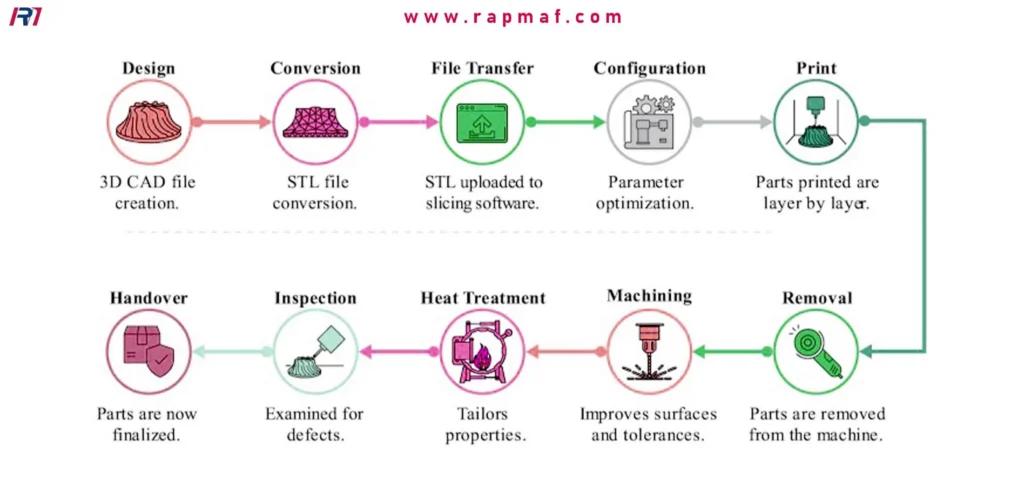
Step 2: Machine Preparation & Powder Loading
Our DMLS machine is a high-precision instrument. We treat it like a cleanroom. We ensure the build chamber is completely clean of any stray powder from the previous job. Then, we load the raw material: a vat of virgin or recycled metal powder. This powder is incredibly fine, almost like dust, and each particle is perfectly spherical to ensure it flows and packs evenly.
Step 3: Creating the Inert Atmosphere
This is non-negotiable. At the temperatures we’re dealing with (well over 1,200°C for steel), the metal powder would instantly oxidize or even combust if it came into contact with oxygen. To prevent this, the machine purges all the oxygen from the build chamber and floods it with an inert gas, usually argon or nitrogen. We monitor the oxygen levels until they are below 1,000 parts per million (ppm) before the build can even begin.
Step 4: The First Layer is Spread
The process begins. The machine’s recoater arm, a precise blade or roller, sweeps across the build plate, depositing a single, perfectly uniform layer of metal powder. The thickness of this layer is astonishingly small, typically between 20 and 60 microns (a human hair is about 70 microns thick).
Step 5: The Laser Fuses the Powder
Now the magic happens. The high-powered fiber laser, guided by the sliced file, activates. It rapidly scans across the powder bed, tracing the 2D cross-section of the first layer. In that tiny, focused spot, the powder is heated past its melting point and fuses to the build plate below.
Step 6: The Cycle Repeats… For Hours or Days
Once the first layer is fused, the build plate lowers by one layer height (e.g., 40 microns). The recoater arm sweeps across again, depositing a fresh layer of powder. The laser then activates and fuses the new layer to the solid layer beneath it. This cycle—lower, recoat, fuse—is repeated thousands upon thousands of times. A small part might take 8-10 hours, while a large, complex component can run for several days straight.
Step 7: The Cooldown
Once the final layer is fused, the build is complete. But you can’t just open the door. The finished part and the surrounding powder are still extremely hot. The machine enters a controlled cooldown phase, allowing the part to cool slowly over several hours to minimize residual thermal stress.
Step 8: Part “Excavation” (Depowdering)
After cooldown, we open the machine and are met with a “cake” of unfused powder. The solid part is completely buried inside. This is the messy part. Using vacuum systems and brushes, we carefully excavate the part and the build plate. The good news is that up to 98% of the unfused powder can be sieved and recycled for future builds, making the process highly material-efficient.
Step 9: Critical Post-Processing
The part that comes out of the machine is not finished. It’s in a “near-net-shape” state and requires several critical post-processing steps:
- Stress Relief: The part, still attached to the build plate, is placed in a furnace for a heat treatment cycle. This normalizes the metal’s internal crystal structure, removing the stresses built up during the rapid heating and cooling cycles.
- Support Removal: The part is separated from the build plate, usually with a wire EDM or bandsaw. Then, the tedious work of removing the metal support structures begins, using hand tools, grinders, or CNC machining.
- Surface Finishing: The raw DMLS part has a slightly rough, matte finish. Depending on the application, we might use bead blasting, tumbling, or CNC machining on critical surfaces to achieve the required smoothness and dimensional accuracy.
Case Study: The Impossible Bracket (Solving Problems CNC Machining Can’t Touch)
To show you why we invest millions in this technology, let me tell you about a project we did for an aerospace client.
- The Problem: The client had a critical bracket for a satellite component. It was CNC machined from a solid block of aluminum. It worked perfectly, but it was heavy. In aerospace, every gram costs a fortune to launch into orbit. They needed to make it significantly lighter without compromising its strength.
- The Traditional Limitation: With CNC machining, you are limited by subtraction. You can mill away material from the outside, drill holes, and create pockets. But you can’t create complex internal structures. You can’t hollow out the part in an organic way. The best they could do with CNC was a blocky, pocketed design that was only a marginal improvement.
- The Additive Solution (DMLS): We took a different approach. Instead of asking, “What can we remove?” we asked, “What is the absolute minimum material needed to do the job?”
- Topology Optimization: We used advanced software to run a “topology optimization.” We told the software the load points (where the bracket would be bolted) and the forces it would experience. The software then ran thousands of simulations, adding material only where stress existed and removing it from everywhere else.
- The Result: The output wasn’t a blocky bracket. It was an organic, skeletal structure that looked more like bone than a machine part. It had a complex internal lattice structure that was incredibly strong but mostly hollow. This design was literally impossible to manufacture with any other method.
- Printing & Finishing: We printed the new bracket design on our DMLS machine using a high-strength aluminum alloy (AlSi10Mg). After post-processing and stress relief, the part was ready.
- The Outcome & Why It Matters:
- Weight Reduction: The new, 3D printed bracket was 55% lighter than the original CNC-machined version.
- Performance: It met or exceeded all the original strength and stiffness requirements.
- The Takeaway: We didn’t just make a lighter part. We used metal 3D printing to create a fundamentally better and more efficient design that was previously unimaginable. This is the true power of the technology—it frees engineers from the constraints of traditional manufacturing.
The Big Question: How Much Does Metal 3D Printing Cost?
This is the most common question we get, and the honest answer is: it depends entirely on the project. There is no simple price-per-kilogram like there is with raw steel. Metal 3D printing is a high-value service, and its cost is a complex equation driven by several major factors.
Think of it less like buying a raw material and more like booking time on a multi-million-dollar machine run by a team of highly skilled engineers.
Here’s a transparent breakdown of what actually goes into the price of a metal 3D printed part:
Factor 1: Machine Capital & Operation
Industrial metal 3D printers are not desktop toys; they are incredibly sophisticated machines that cost anywhere from $500,000 to over $2 million. This capital investment, along with the costs of maintenance, power, and the inert gases (argon) needed to run the machine, contributes significantly to the hourly operating rate.
Factor 2: Material Cost
The metal powder used in PBF processes is far more expensive than its equivalent in bar stock or plate form. The process of atomizing metal into perfectly spherical, microscopic particles is highly specialized.
- Common Powders: Stainless steel (316L) or Aluminum (AlSi10Mg) powders can range from $50 – $150 per kilogram.
- Exotic Powders: High-performance alloys like Inconel, titanium, or specialized tool steels can easily cost $300 – $500+ per kilogram.
While the unfused powder is largely recyclable, this initial material cost is a significant driver.
Factor 3: Build Time & Volume
This is the most direct cost factor. The longer your part takes to print, the more it will cost. This is a function of the part’s total volume. The laser must sinter every single cubic millimeter of your part, layer by layer. A larger or taller part will naturally require more machine time.
Factor 4: Labor & Post-Processing (The Hidden Cost)
This is the factor most people underestimate. A huge portion of the cost of a metal 3D printed part comes from the skilled labor required after the print is finished. As we detailed in the workflow, this includes:
- Engineering Setup: Time spent by an engineer orienting the part and designing support structures.
- Depowdering: The manual labor of carefully excavating and cleaning the part.
- Heat Treatment: Running a furnace cycle for stress relief.
- Support Removal & Surface Finishing: This is the most labor-intensive part, often requiring hours of work by a skilled technician using CNC machines, grinders, and hand tools.
| Cost Factor | Metal 3D Printing (DMLS/SLM) | Traditional CNC Machining |
|---|---|---|
| Setup Cost | Moderate (Digital file prep) | High (Fixturing, tooling, programming) |
| Material Cost | Very High (Specialized powder) | Moderate (Standard bar stock) |
| Per-Part Cost | High & Relatively Constant | Decreases Sharply with Volume |
| Post-Processing | Very High & Mandatory | Varies by design, often lower |
| Best For | Prototypes, complex geometries, low-volume production | High-volume production, simpler geometries |
The Bottom Line on Price: A small, simple part made from stainless steel might start in the low hundreds of dollars. A medium-sized, complex part made from titanium could easily be several thousand dollars. The price is justified when the technology enables a design or performance that is simply impossible to achieve otherwise.
The Disadvantages of Metal 3D Printing: 4 Key Realities
While the technology is revolutionary, it is not a magic bullet. As engineers, we have to be honest about its limitations. Here are the four main reasons why metal 3D printing hasn’t replaced traditional manufacturing.
Disadvantage 1: It’s Expensive
As detailed above, the combination of high machine cost, expensive materials, and intensive labor makes metal 3D printing a costly process. For a simple bracket that can be easily machined, CNC will be cheaper 99% of the time, especially once you need more than a handful of them.
Disadvantage 2: It’s Slow for Mass Production
The layer-by-layer process is inherently slow. A build can take anywhere from 10 hours to 10 days. If you need 10,000 identical parts, traditional methods like investment casting or high-volume CNC machining will produce them much faster and at a dramatically lower cost per unit.
Disadvantage 3: Extensive Post-Processing is Required
The part that comes out of the printer is not the final part. The need for heat treatment, support removal, and surface finishing adds significant time, cost, and complexity to the workflow. This is a crucial point that is often glossed over in marketing materials.
Disadvantage 4: Limited Build Volume
Even large, industrial metal 3D printers have a limited build envelope. A typical large-frame machine might have a build volume of around 400 x 400 x 400 mm (about 16 x 16 x 16 inches). For very large components, like an automotive engine block or large structural frames, traditional methods like casting and fabrication are still the only options.
Is Anything Illegal to 3D Print?
This is a common question, and it’s important to address it from the perspective of a professional manufacturing service. The legality of 3D printing an object depends on what the object is and who owns the design.
- Intellectual Property (IP): It is illegal to 3D print an object that is protected by a patent, copyright, or trademark without the owner’s permission. This is the same as any other form of manufacturing.
- Firearms: The 3D printing of firearms is a highly regulated and legally complex area. In the United States, for example, the Undetectable Firearms Act places restrictions on firearms that cannot be detected by metal detectors. As a professional and ethical manufacturing partner, RM (Rapid Manufacturing) does not, under any circumstances, produce firearms, firearm components, or related regulated items.
- Other Restricted Items: This can include printing illegal items like lock-picking tools, key duplicators for restricted keys, or other objects intended for illicit purposes.
Our policy is clear: we work with engineers, designers, and businesses to create innovative and legitimate products. We adhere strictly to all local and international laws regarding manufacturing and intellectual property.
Conclusion: The Right Tool for the Impossible Job
So, how does a metal 3D printer work? It works by using a powerful laser to transform fine metal powder into a solid, functional part, layer by meticulous layer.
It is not a magic “replicator” that will replace all other forms of manufacturing. Instead, it is the ultimate problem-solver. It is the tool we reach for when a client brings us a challenge that is too complex, too intricate, or too lightweight for CNC machines to handle.
Metal 3D printing shines when it is used to:
- Create Impossible Geometries: Conformal cooling channels, internal lattices, and organic shapes.
- Achieve Radical Lightweighting: As seen in our aerospace case study.
- Consolidate Assemblies: Combining multiple complex parts into a single, stronger printed component.
- Rapidly Prototype Metal Parts: Getting a functional metal prototype in days instead of weeks.
It is a powerful and essential tool in the modern manufacturing toolbox, standing alongside CNC machining, casting, and fabrication. The key is knowing which tool to use for the job.
If you have a project that you think might be a fit for metal 3D printing, contact our engineering team. We’ll give you an honest assessment and help you determine the best manufacturing path to bring your innovation to life.
Frequently Asked Questions (FAQs)
Q1: How does a 3D printer print metal?
A1: The most common method is Powder Bed Fusion (PBF). A machine spreads a thin layer of fine metal powder, and a high-powered laser melts and fuses the powder in specific areas based on a 3D model. The process repeats, building the part layer by layer, until the final solid object is formed.
Q2: How much would it cost to 3D print metal?
A2: The cost is highly variable. Small, simple parts can start in the low hundreds of dollars, while large, complex parts made from exotic materials can cost many thousands. The price depends on the material used, the total volume of the part (which determines machine time), and the amount of skilled labor needed for post-processing.
Q3: Is anything illegal to 3D print?
A3: Yes. It is illegal to print objects that violate intellectual property laws (patents, copyrights). It is also illegal and highly regulated to print items like undetectable firearms, certain weapon components, and other illicit tools. Professional manufacturing services will not produce these items.
Q4: What are the disadvantages of 3D metal printing?
A4: The four main disadvantages are: 1) High cost compared to traditional methods for simple parts. 2) Slower speed, making it unsuitable for high-volume mass production. 3) The extensive and mandatory post-processing required (heat treatment, support removal). 4) A limited build volume compared to other manufacturing technologies.
References
- ASTM F3187-16 – Standard Guide for Directed Energy Deposition of Metals: This standard from the leading materials testing organization outlines the principles of a key metal additive manufacturing process.
- Wohlers Report 2023, “Additive Manufacturing and 3D Printing State of the Industry”: The most authoritative annual report on the 3D printing industry, providing data on growth, materials, and applications.
- “Metal Additive Manufacturing: A Review” – Journal of Materials Processing Technology: An academic review detailing the metallurgical principles and challenges of metal 3D printing processes.
Disclaimer
The information on this page is for informational purposes only. RM makes no representations or warranties, express or implied, as to the accuracy or completeness of this information. For any third-party services procured through the RM network, it is the buyer’s responsibility to specify and confirm performance parameters, tolerances, materials, and workmanship during the quotation process. For more detailed information, please do not hesitate to contact us.
RM: Your Precision Manufacturing Partner
RM is an industry leader in custom manufacturing solutions. With over 20 years of profound experience, we have become the trusted partner for more than 5,000 clients worldwide. We specialize in a comprehensive range of manufacturing services—including high-precision CNC machining, sheet metal fabrication, 3D printing, injection molding, and metal stamping—to provide you with a true one-stop-shop experience.
Our world-class facility is equipped with over 100 state-of-the-art 5-axis machining centers and operates in strict compliance with the ISO 9001:2015 quality management system. We are dedicated to providing solutions that blend speed, efficiency, and exceptional quality to customers in over 150 countries. From rapid prototyping to large-scale production, we promise delivery in as fast as 24 hours, helping you gain a competitive edge in the market. Choosing RM means selecting an efficient, reliable, and professional manufacturing ally.
Explore our capabilities today by visiting our website: www.rapmaf.com







24 Responses