


In the world of manufacturing and fabrication, joining two pieces of metal together is a fundamental task. While welding often steals the spotlight with its dramatic arcs and sparks, two other, more subtle methods are responsible for holding together everything from your home’s plumbing to critical aerospace components: brazing and soldering.
To the untrained eye, they look almost identical. Both involve heating metal parts and flowing a molten filler material into the joint. Yet, they are fundamentally different processes with vastly different capabilities. Choosing the wrong one can lead to catastrophic failure.
So, what is the real difference between brazing and soldering?
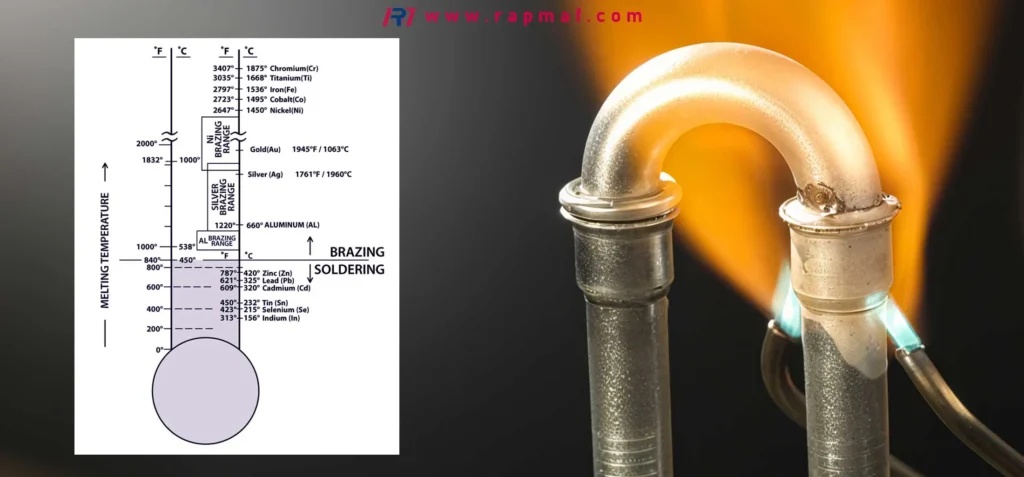
The short answer is temperature. Brazing is a higher-temperature process (above 450°C / 840°F) that uses a stronger filler metal, creating a bond that is often stronger than the base metals themselves. Soldering is a lower-temperature process (below 450°C / 840°F) that is ideal for sensitive electronic components but creates a much weaker mechanical bond.
This guide will move beyond that simple answer. We will explore the science behind each method, compare their strengths and weaknesses, and provide the expert framework you need to make the right choice for your project.
The Defining Line: 450°C (840°F)
In material science, clear, unambiguous definitions are everything. The American Welding Society (AWS) has drawn a definitive line in the sand that separates these two processes: 450°C (840°F).
- If the filler metal you are using melts below this temperature, you are soldering.
- If the filler metal you are using melts above this temperature, you are brazing.
This isn’t an arbitrary number. This temperature threshold represents a significant shift in the types of filler metals used and the resulting strength of the joint. It’s the first and most important question to ask when identifying a joining process.
What is Soldering? The Low-Temp Specialist
Soldering is the process most people are familiar with, often from electronics hobbies or basic plumbing work.
The Core Process:
- Cleaning: The surfaces of the two base metals (e.g., a copper wire and a circuit board pad) are meticulously cleaned.
- Flux Application: A chemical cleaning agent called flux is applied to the joint. When heated, the flux removes oxides and prevents new ones from forming, allowing the solder to bond properly.
- Heating: The base metals are heated to a temperature above the solder’s melting point but below their own. A soldering iron is a common tool for this.
- Flowing the Filler: The solder (a tin-based alloy) is touched to the heated parts (not the iron), where it instantly melts and is pulled into the joint by a phenomenon called capillary action.
- Cooling: The heat is removed, and the solder solidifies, creating both a mechanical connection and, crucially for electronics, an electrical pathway.
Key Characteristics of Soldering:
- Low Temperature: Protects heat-sensitive components like transistors and microchips.
- Weaker Bond: The mechanical strength of a solder joint is low. It’s not intended for high-stress structural applications.
- Excellent Electrical Conductivity: The primary reason it’s the standard for electronics.
- Reversible: A solder joint can be easily melted and reworked, which is ideal for repairs.
What is Brazing? The High-Strength Contender
Brazing operates on the same principle of capillary action but at a much higher level of performance.
The Core Process:
- Cleaning & Fit-Up: Like soldering, parts must be perfectly clean. However, the gap between the parts (the “joint clearance”) is critical and must be carefully controlled—typically between 0.025 to 0.13 mm (0.001 to 0.005 inches).
- Flux Application: A specialized high-temperature flux is applied. In some industrial processes, this is done in a vacuum or controlled atmosphere furnace, which removes the need for flux.
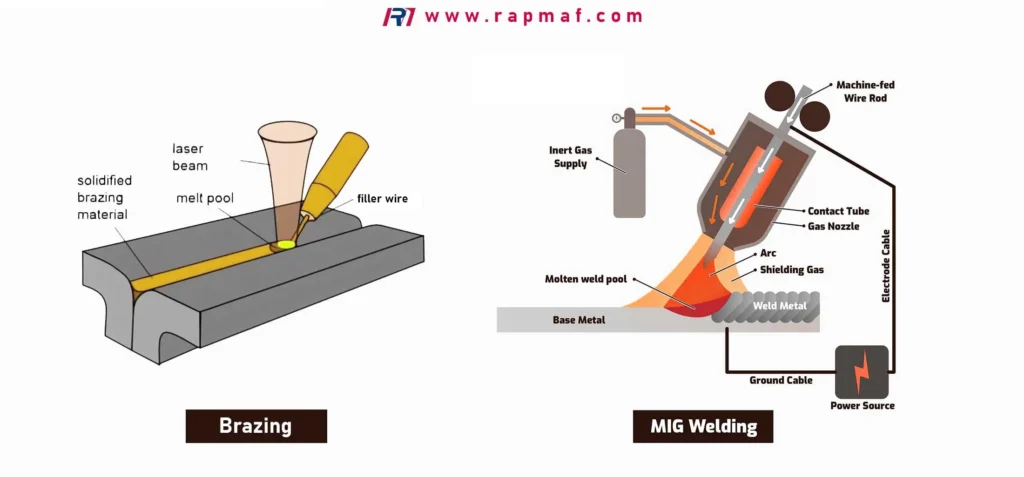
- Heating: The entire assembly is heated uniformly to a temperature above the brazing filler metal’s melting point. This is usually done with a torch, an induction coil, or inside a furnace.
- Flowing the Filler: The brazing filler metal (often a copper, silver, or nickel alloy) is introduced to the joint, where it melts and is drawn into the capillary gap.
- Cooling & Cleaning: The assembly is cooled, allowing the filler metal to solidify. Post-braze cleaning is often required to remove any remaining flux residue, which can be corrosive.

Key Characteristics of Brazing:
- High Temperature: The base metals are not melted, but the process requires significant heat.
- Extremely Strong Bond: A properly designed braze joint is incredibly strong. The filler metal diffuses slightly into the base metals, creating a metallurgical bond that can be stronger than the materials it joins.
- Joins Dissimilar Metals: Brazing is one of the best ways to join completely different materials, such as copper to steel or carbide to steel (as seen in saw blades).
- Permanent: A brazed joint is a permanent, structural connection.
We’ve now defined the two processes and established the critical temperature line that separates them. But how does this translate into real-world performance? In the next part, we will put them in a direct head-to-head showdown, comparing everything from strength to cost, and present a real-world case study from RM where brazing was the only solution for a high-performance application.
The Head-to-Head Showdown: Brazing vs. Soldering
While temperature is the defining line, the consequences of that temperature difference ripple through every aspect of the joint’s performance.
Strength & Durability: The Decisive Difference
This is the most critical distinction. The strength of a joint determines its ability to withstand mechanical stress, vibration, and shock.
- Brazing: Creates an exceptionally strong, permanent, metallurgical bond. During the brazing process, the filler metal doesn’t just stick to the surface; it actively interacts with the base metals through a process of diffusion. This creates a blended region, or “fillet,” that integrates the filler with the parent materials. A well-designed braze joint can have a tensile strength ranging from 40,000 to over 100,000 PSI. In many cases, if a brazed assembly is tested to destruction, the base metal will fail before the braze joint does.
- Soldering: Creates a relatively weak mechanical bond. Solder adheres to the surface of the base metals but does not significantly diffuse into them. It’s a surface-level bond, which is why it’s excellent for electrical continuity but poor for structural integrity. The tensile strength of a typical solder joint is much lower, usually in the range of 4,000 to 10,000 PSI. It is not suitable for load-bearing applications and is susceptible to failure from vibration or shock.
Winner: Brazing, by an enormous margin.
Temperature & Thermal Cycling Resistance
A joint is only useful if it can survive its operating environment.
- Brazing: Because it’s created at a high temperature, a brazed joint can naturally operate at much higher service temperatures. Brazed joints can often withstand continuous service temperatures of 200°C (400°F) to over 1000°C (1800°F), depending on the specific filler alloy used. This makes them ideal for applications involving heat exchangers, exhaust systems, and high-power industrial equipment. They also handle thermal cycling (repeated heating and cooling) very well.
- Soldering: A solder joint has a very limited service temperature range. Since the solder itself melts at a low temperature, it will lose its strength and fail long before a brazed joint would. Most common solders should not be used in environments above 100-125°C (212-257°F). They are also more prone to fatigue and failure from thermal cycling.
Winner: Brazing.
Base Material Compatibility
How well does the process work with different types of metals?
- Brazing: This is one of brazing’s superpowers. Because the base metals are never melted, you can join wildly dissimilar materials with ease. It is the preferred method for joining steel to copper, aluminum to copper, stainless steel to brass, and even metals to non-metals like ceramics (using specialized filler metals). This versatility is a massive advantage in complex assemblies.
- Soldering: Soldering works well on common, highly conductive metals like copper, brass, tin, and silver. However, it is very difficult to solder to metals that form tough, stable oxides, such as stainless steel, aluminum, or titanium, without using highly aggressive and corrosive fluxes. Joining dissimilar metals is possible but much more limited than with brazing.
Winner: Brazing.
Process Complexity & Skill
- Brazing: Requires a higher level of skill and process control. Managing the high heat of a torch or furnace to ensure even heating without overheating or melting the base metals takes practice. Furthermore, the joint clearance (the gap between the parts) must be precisely controlled to enable proper capillary action.
- Soldering: Is far more accessible to beginners. A simple soldering iron is inexpensive and relatively easy to control. The process is more forgiving of variations in technique and joint fit-up, especially in non-critical applications.
Winner: Soldering (for ease of use).
Comparison Summary: Brazing vs. Soldering
| Feature | Brazing | Soldering |
|---|---|---|
| Defining Temp. | > 450°C (840°F) | < 450°C (840°F) |
| Joint Strength | Very High (Often stronger than base metals) | Low (Primarily for electrical/low-stress seals) |
| Service Temp. | High (200°C to 1000°C+) | Very Low (< 125°C) |
| Capillary Action | Yes (Primary mechanism) | Yes (Primary mechanism) |
| Base Metal Melting | No | No |
| Dissimilar Metals | Excellent (Major advantage) | Limited (Requires special fluxes) |
| Common Filler | Silver, Copper, Nickel, Aluminum Alloys | Tin-Lead, Tin-Silver, Tin-Copper Alloys |
| Typical Heat Source | Torch, Furnace, Induction | Soldering Iron, Hot Air, Reflow Oven |
| Primary Use Case | Structural joints, fluid systems, tooling | Electronics, low-pressure plumbing |
| Skill Required | High | Low to Moderate |
Case Study: RM and the High-Pressure Medical Heat Exchanger
This table highlights the differences, but a real-world example from our shop at RM (Rapid Manufacturing) shows why this knowledge is mission-critical.
The Client: A leading medical device company developing a new blood analysis machine.
The Problem: The machine required a miniature heat exchanger to precisely control the temperature of fluid samples. The design involved joining a thin-walled stainless steel tube (for its cleanliness and corrosion resistance) to a machined brass manifold (for its excellent thermal conductivity). The assembly would be subjected to constant thermal cycling and pressures up to 500 PSI.
The Initial (Failed) Approach: The client’s initial prototype supplier had attempted to join the parts using a high-grade, lead-free solder. During early testing, the device passed initial leak checks but failed catastrophically after only a few hundred thermal cycles. The solder joint cracked, causing a high-pressure leak.
The RM Solution: When the client brought the project to us, our engineering team immediately identified the issue. Soldering was fundamentally the wrong choice for three reasons:
- Strength: The 500 PSI internal pressure exerted a hoop stress on the joint that far exceeded the solder’s safe load limit.
- Thermal Fatigue: The repeated expansion and contraction of the stainless steel and brass during heating and cooling was fatiguing the weak solder bond.
- Material Incompatibility: Getting a reliable solder bond on stainless steel is notoriously difficult.
Our team at RM re-engineered the joining process using torch brazing.
- We selected a silver-based brazing alloy (BAg-7) for its excellent flow characteristics on both stainless and brass and its high ductility, which helps absorb thermal stress.
- We specified a precise joint clearance of 0.05 mm to maximize capillary action and joint strength.
- Using a high-temperature black flux and precise torch control, our technicians created a perfect braze joint.
The Result: The new, brazed heat exchanger was flawless. It withstood over 50,000 thermal cycles and a proof pressure test of 2000 PSI (4x the operating pressure) without any signs of failure. The client was able to move forward with a reliable product, saving months of redesign and re-testing. This is a perfect example of how choosing brazing over soldering isn’t just a minor detail—it’s the difference between success and failure. You can learn more about our advanced manufacturing solutions at rapmaf.com.
We have now definitively compared the two processes. But there’s one more major player we need to bring into the discussion: welding. How does brazing, which never melts the base metal, compare to the ultimate fusion process? In the final part, we will compare brazing to welding and provide a final decision-making framework for all three major joining methods.
What is Welding? The Principle of Fusion
If brazing is a super-strength glue, welding is molecular fusion.
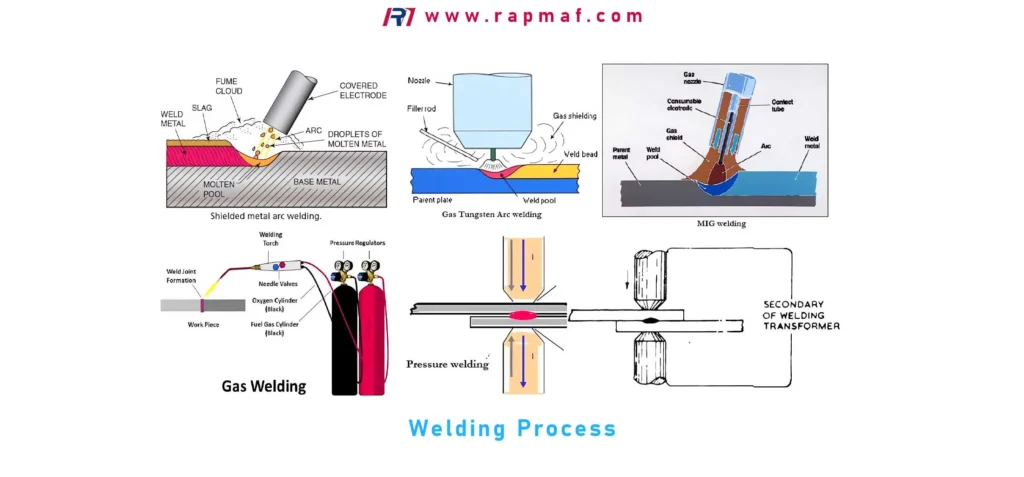
Welding is a fabrication process that joins materials, usually metals or thermoplastics, by using high heat to melt the base parts together and allowing them to cool, causing fusion.
This is the absolute, non-negotiable difference. In welding, the edges of the parent materials themselves are brought to their melting point. Often, a filler material (like a welding rod or wire) is also melted into the molten pool to add bulk and strength. As this pool of mixed, molten metal cools and solidifies, the two separate pieces become a single, continuous piece of material.
The heat required to do this is immense, far exceeding that of brazing, and can be generated by various means: an electric arc (Arc Welding), a gas flame (Oxy-acetylene), a laser, or an electron beam.
The Final Showdown: Brazing vs. Welding
This fundamental difference—joining with a filler vs. fusing the base metals—creates a new set of trade-offs that every engineer must master.
Strength & Joint Integrity
This is the reason welding dominates heavy industry. A properly executed weld is not considered a “joint” in the same way a braze is; it is a continuation of the base metal.
- Welding: Creates the strongest possible bond. The finished joint, once cooled, has the same or even greater tensile strength than the original parent materials. This is why welding is the only choice for building skyscrapers, ship hulls, pressure vessels, and high-stress vehicle frames. The joint becomes a monolithic structure.
- Brazing: Creates an incredibly strong joint, but it is still a layered system. The strength is determined by the brazing alloy and the integrity of the bond between the alloy and the base metals. While a braze can be stronger than the base metals in some shear tests, it generally does not match the ultimate tensile strength of a fully fused weld in a like-for-like material.
Winner: Welding (for absolute maximum strength).
Heat Input & The Heat-Affected Zone (HAZ)
The immense heat of welding comes at a price. When you melt metal, you unavoidably heat the area around it. This creates what is known as the Heat-Affected Zone (HAZ).
- Welding: Creates a large and significant HAZ. The intense, concentrated heat can change the crystalline structure of the metal adjacent to the weld, altering its mechanical properties. For example, it can make hardened steel brittle or reduce the corrosion resistance of stainless steel. This high heat also introduces massive thermal stresses, which can cause thin materials to warp and distort significantly. Managing this distortion is a major challenge in weld engineering.
- Brazing: This is brazing’s greatest advantage over welding. Because the heat is lower and is distributed more evenly across the entire joint, the HAZ is minimal and the risk of distortion is dramatically lower. This makes brazing the superior choice for delicate, precision assemblies or joining thin-walled tubes where warping would be catastrophic.
Winner: Brazing (for preserving material properties and preventing distortion).
Dissimilar Materials
- Welding: Joining dissimilar metals is a metallurgical nightmare. Trying to melt and fuse two metals with different melting points, thermal expansion rates, and chemical compositions often results in brittle, cracked, and useless joints. It is possible in some specific cases with advanced techniques (like explosive welding or friction stir welding), but it is generally not feasible with common methods.
- Brazing: Excels at this. Since the base metals are never melted, their metallurgical differences are far less important. As long as the brazing alloy is chemically compatible with both surfaces, you can create a strong bond. Brazing is the go-to method for joining steel to copper, aluminum to brass, or even metals to advanced ceramics.
Winner: Brazing (by a landslide).
Post-Processing and Aesthetics
- Welding: Welded joints, particularly from stick or flux-cored arc welding, are often rough, uneven, and covered in slag and spatter. They almost always require significant post-processing like grinding, sanding, or machining to achieve a smooth and clean finish.
- Brazing: The capillary action inherent in brazing produces a very neat, clean, and smooth fillet. A well-executed braze joint is aesthetically pleasing and typically requires little to no finishing work, saving significant time and labor.
Winner: Brazing.
The Final Verdict: Your 3-Way Decision Framework
We have now explored all three major joining processes. They are not a hierarchy of “good, better, best,” but a toolkit of specialized solutions. The choice depends entirely on the demands of the application.
Here is the definitive framework to guide your decision:
Choose SOLDERING when:
- Primary Need: Electrical conductivity is the main goal.
- Strength Requirement: Very low; the joint is not load-bearing.
- Operating Temperature: Low (near room temperature).
- Materials: Common conductive metals like copper or tin-plated surfaces.
- Example: Assembling components on a Printed Circuit Board (PCB).
Choose BRAZING when:
- Primary Need: High strength on dissimilar materials.
- Strength Requirement: High, but absolute maximum fusion is not needed.
- Key Constraint: You must minimize heat distortion and preserve the base metals’ properties.
- Assembly: Complex shapes, thin-walled tubes, or parts requiring a clean finish with no post-processing.
- Example: Joining a carbide cutting tip to a steel tool shank, or our medical heat exchanger case study.
Choose WELDING when:
- Primary Need: Absolute maximum strength and a monolithic structure.
- Strength Requirement: The joint must be as strong as or stronger than the parent material.
- Materials: The parts are made of the same or very similar metals.
- Geometry: The parts are thick enough to handle the high heat input without unacceptable distortion.
- Example: Fabricating a steel I-beam for a building or assembling a high-pressure steel pipeline.
Conclusion: The Right Tool for the Right Job
The journey from the low-temperature world of soldering, through the high-strength versatility of brazing, to the ultimate fusion of welding is a journey through the core of manufacturing. There is no single “best” method, only the most appropriate one.
Understanding the fundamental differences in temperature, strength, and material interaction is what separates amateur craft from professional engineering. It’s the knowledge that prevents catastrophic failures, enables innovative designs, and ultimately delivers a reliable, high-quality product. At RM, this deep material and process expertise is at the core of everything we do, ensuring that whether your project requires the delicate touch of a solder joint or the raw power of a full-penetration weld, the right choice is made every time.
Ready to discuss the right joining method for your next project? Contact the experts at RM today.
Frequently Asked Questions (FAQs)
1. Which is stronger: brazing, soldering, or welding?
There is a clear strength hierarchy: Welding is the strongest, followed by brazing, with soldering being the weakest.
- Welding creates a joint that is as strong as, or even stronger than, the original base materials by fusing them into a single piece.
- Brazing creates a very strong bond using a filler metal that is often stronger than one of the base metals, but the joint’s strength is limited by the bond between the filler and the base parts.
- Soldering uses a low-temperature, soft filler metal, resulting in a joint with significantly lower mechanical strength, primarily intended for electrical conductivity.
2. Why would you ever choose brazing if welding is stronger?
This is the critical engineering trade-off. You choose brazing over welding when other factors are more important than achieving the absolute maximum strength. The primary reasons are:
- Joining Dissimilar Metals: Brazing is the superior method for joining different materials like copper to steel, which is extremely difficult or impossible with traditional welding.
- Minimizing Heat Distortion: Welding’s intense heat can warp and damage thin or delicate parts. Brazing uses much lower, more evenly distributed heat, preserving the part’s dimensions and integrity.
- Preserving Material Properties: The high heat of welding creates a Heat-Affected Zone (HAZ) that can alter the base metal’s properties (e.g., making it brittle). Brazing avoids this, keeping the base metals in their original condition.
- Cleaner Finish: Brazed joints are naturally smoother and require far less cleanup and grinding than most welded joints.
3. When should you braze copper pipes instead of soldering them?
The choice depends on the application’s pressure and temperature.
- Solder is used for standard, low-pressure residential plumbing for water.
- Braze is required for high-pressure applications like HVAC refrigerant lines, medical gas systems, and in systems where operating temperatures would melt solder. The brazed joint is significantly stronger and more reliable under stress and vibration.
4. What are the main disadvantages of brazing?
While versatile, brazing has its limitations:
- Lower Strength than Welding: It cannot match the monolithic strength of a properly fused weld.
- Requires High Cleanliness: The parts must be perfectly clean for the capillary action to work correctly. Any grease or oxide layer will ruin the joint.
- Filler Metal Cost: Some high-performance brazing alloys, particularly those with high silver content, can be more expensive than welding consumables.
5. Can you braze aluminum?
Yes, but it is a specialized and challenging process. Aluminum brazing requires very precise temperature control because aluminum’s melting point is very close to the melting point of the brazing filler alloys used for it. It also requires special fluxes to deal with the tough, persistent aluminum oxide layer that forms instantly on the surface.
References
- American Welding Society (AWS). Brazing Handbook (5th ed.). (The definitive industry guide on all aspects of brazing science and application).
- O’Brien, R. L. (Ed.). Jefferson’s Welding Encyclopedia (18th ed.). American Welding Society. (A comprehensive reference for all welding and allied processes).
- Kalpakjian, S., & Schmid, S. R. (2014). Manufacturing Engineering and Technology (7th ed.). Pearson. (A leading textbook covering the theory and practice of brazing, soldering, and welding in dedicated chapters).
Disclaimer
The information on this page is for informational purposes only. RM makes no representations or warranties, express or implied, as to the accuracy or completeness of this information. For any third-party services procured through the RM network, it is the buyer’s responsibility to specify and confirm performance parameters, tolerances, materials, and workmanship during the quotation process. For more detailed information, please do not hesitate to contact us.
RM: Your Precision Manufacturing Partner
RM is an industry leader in custom manufacturing solutions. With over 20 years of profound experience, we have become the trusted partner for more than 5,000 clients worldwide. We specialize in a comprehensive range of manufacturing services—including high-precision CNC machining, sheet metal fabrication, 3D printing, injection molding, and metal stamping—to provide you with a true one-stop-shop experience.
Our world-class facility is equipped with over 100 state-of-the-art 5-axis machining centers and operates in strict compliance with the ISO 9001:2015 quality management system. We are dedicated to providing solutions that blend speed, efficiency, and exceptional quality to customers in over 150 countries. From rapid prototyping to large-scale production, we promise delivery in as fast as 24 hours, helping you gain a competitive edge in the market. Choosing RM means selecting an efficient, reliable, and professional manufacturing ally.
Explore our capabilities today by visiting our website: www.rapmaf.com