



The short answer is 1084.62 °C (1984.32 °F).
But in engineering and manufacturing, that number is far more than a simple piece of trivia. It’s a fundamental property that dictates how we use, shape, and design with one of humanity’s most important metals. It’s the gatekeeper temperature that separates a solid, reliable electrical conductor from a molten liquid, and understanding its context is key to understanding copper itself.
This guide won’t just give you the number; it will explain why that number matters. We’ll explore what happens to copper at an atomic level as it approaches this critical point and why its specific melting temperature gives it a unique “Goldilocks” advantage in the world of materials.
Beyond the Number: Why Copper’s Melting Point Matters
A material’s melting point is a direct reflection of the strength of the metallic bonds holding its atoms together. For engineers, it’s a critical data point that influences everything from manufacturing processes to a component’s potential failure points. Copper’s melting point is particularly significant for three key reasons.

The “Goldilocks Zone” of Workability and Durability
Copper’s melting point of 1084.62 °C places it in an incredibly useful middle ground compared to other common metals.
- It’s not too low. Metals like lead (327.5 °C) and tin (231.9 °C) are easy to melt, but they lack the structural integrity and high-temperature performance needed for many applications. You can’t run significant electrical current through a lead wire without it getting dangerously hot and losing strength. Copper, however, can handle the thermal load of electrical resistance and operate in high-performance environments like motors and transformers without risk of melting.
- It’s not too high. On the other end of the spectrum is steel, with a melting point typically above 1370 °C (2500 °F). This high temperature requires immense energy, specialized furnaces, and complex processes to melt and cast. Copper’s more accessible melting point means it can be melted and formed with less energy and simpler equipment, making processes like casting and alloying far more economical.
This “Goldilocks” property makes copper uniquely versatile. It is durable enough for demanding electrical and plumbing applications but workable enough to be efficiently manufactured into complex shapes like wires, tubes, and heat exchangers.
A Gateway to Manufacturing and Alloying
The practicality of copper’s melting point is the foundation for many manufacturing techniques.
- Casting: Because 1084 °C is readily achievable in industrial furnaces, copper is easily melted down and poured into molds to create solid parts. This is fundamental for producing everything from bronze sculptures (a copper alloy) to electrical busbars.
- Joining: The melting point is critical for joining processes. When you solder a copper pipe, you use a filler metal (solder) with a much lower melting point (around 180-190 °C). This allows you to create a strong, permanent bond by melting the solder without ever coming close to melting the copper pipe itself. This principle is essential for plumbing, electronics, and countless other applications.
- Alloying: Copper is the base metal for two of the most important alloys in history: brass (copper + zinc) and bronze (copper + tin). The ability to easily melt copper allows metallurgists to precisely mix in other elements, creating new materials with enhanced properties like superior strength (bronze) or excellent machinability (brass).
An Indicator of Purity
For metallurgists, a material’s melting point is a key indicator of its purity. Pure copper has a very precise and sharp melting point. When impurities are introduced, they disrupt the neat, orderly crystal structure of the copper atoms. This disruption weakens the bonds slightly, which typically lowers and broadens the melting point. Instead of melting at one exact temperature, an impure sample will melt over a range of temperatures. Therefore, testing for a sharp, consistent melting point at 1084.62 °C is a reliable method for verifying the purity of a copper sample.
The Science: What Happens When Copper Melts?
To truly understand the melting point, we need to zoom in to the atomic level.
In its solid state, copper atoms are arranged in a highly organized, repeating crystal structure known as a Face-Centered Cubic (FCC) lattice. Imagine a grid of atoms held firmly in place by strong metallic bonds—a sea of shared electrons flowing between the atomic nuclei. The atoms aren’t perfectly still; they vibrate in place, and the energy of this vibration is what we perceive as heat.
As you heat a piece of copper, you are pumping thermal energy into this system. The atoms vibrate more and more violently. They push against their neighbors, causing the copper to expand (a phenomenon known as thermal expansion).
As the temperature approaches 1084.62 °C, the vibrations become so intense that they begin to overcome the metallic bonds that lock the atoms into the rigid lattice. At precisely the melting point, a phase transition occurs. The ordered structure collapses, and the atoms break free from their fixed positions. The copper transforms from a solid with a defined shape into a disordered liquid that takes the shape of its container.
It’s important to note that even when the copper reaches its melting point, it requires a significant amount of extra energy, known as the latent heat of fusion, to complete the transition from solid to liquid. This is the energy required to break the remaining bonds without raising the temperature any further.
We have established the what, why, and how of copper’s melting point. But how does this critical number stack up against its biggest rivals and partners in the industrial world? In the next part, we will compare copper’s melting point directly to that of aluminum, steel, and gold, and explore how these differences dictate which metal gets chosen for a specific job.
Copper vs. Aluminum: The Battle for Thermal and Electrical Conductivity
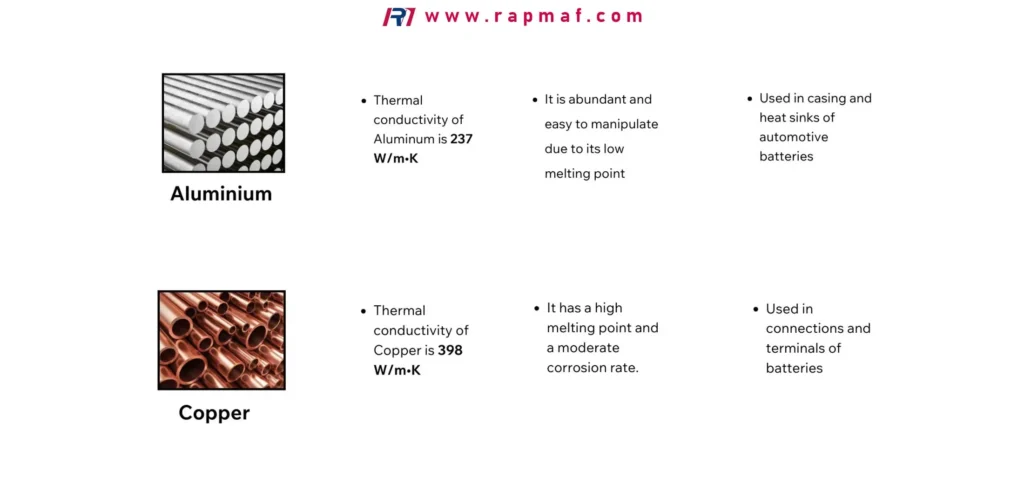
Aluminum is often the first material considered alongside copper, especially for thermal and electrical applications. Its melting point is significantly lower, which is both its greatest strength and its most significant weakness.
- Aluminum’s Melting Point: ~660 °C (1220 °F)
This nearly 400-degree difference is a game-changer in manufacturing. The energy required to melt a material increases dramatically with temperature, making aluminum far cheaper to melt, cast, and extrude into complex shapes. This is why aluminum is ubiquitous in products like extruded window frames and cast engine blocks.
When to Choose Aluminum
The lower melting point makes aluminum the undisputed king of high-volume, cost-sensitive thermal applications.
- Consumer-Grade Heatsinks: The processor in your desktop computer likely has an aluminum heatsink. It’s cheap to produce, can be extruded into complex fin shapes, and provides “good enough” performance for most consumer needs. The lower service temperature is not a problem, as a CPU should never approach 660 °C.
- Automotive Radiators and Condensers: Aluminum’s low cost and light weight make it perfect for automotive heat exchangers. It can handle the typical operating temperatures of an engine’s cooling system (around 90-105 °C) with a huge margin of safety.
When to Choose Copper
Copper enters the picture when “good enough” isn’t good enough and operating temperatures begin to climb.
- High-Performance Computing: In a high-end gaming PC or server, where every degree of cooling translates to more performance, you’ll find copper heatsinks. Copper’s superior thermal conductivity (nearly double that of aluminum) allows it to pull heat away from the processor much faster. The higher manufacturing cost is justified by the performance gain.
- High-Current Electrical Applications: For industrial busbars, transformer windings, and high-power motors, copper is the only viable choice. These applications generate significant heat due to electrical resistance. Aluminum, with its lower melting point, would soften and lose structural integrity under such thermal loads, creating a catastrophic failure risk. Copper’s higher melting point provides the necessary safety margin.
Copper vs. Steel: Workability vs. Raw Strength
This comparison is less about competition and more about two materials built for entirely different worlds. Steel is the backbone of the modern world, and its incredibly high melting point is a primary reason why.
- Carbon Steel’s Melting Point: ~1370-1540 °C (2500-2800 °F)
This immense temperature barrier is what gives steel its incredible strength under extreme conditions. While copper provides a safe margin for electrical applications, steel provides a safe margin for structural and high-temperature applications.
When to Choose Steel
When the primary requirement is strength, especially at high temperatures, there is no substitute for steel.
- Structural Integrity: The I-beams in a skyscraper, the chassis of a car, and the pressure vessel of a boiler are all made of steel. It can withstand immense physical stress and high temperatures without deforming, a property known as “hot strength.”
- Extreme Durability: Engine components like crankshafts and engine blocks are made from iron and steel because they must endure the heat and pressure of internal combustion for millions of cycles. Copper would deform and fail almost instantly in this environment.
When to Choose Copper
You would never build a skyscraper frame from copper, but you’d also never build a high-efficiency motor winding from steel.
- Electrical and Thermal Efficiency: Steel is a relatively poor conductor of both heat and electricity compared to copper. Using steel for wiring would result in massive energy loss as heat. Using it for a heat exchanger would require a unit many times larger and heavier to achieve the same cooling performance as a copper one.
- Manufacturability: The energy and equipment required to melt and shape steel are far more extensive than for copper. This makes copper a more economical choice for applications where its properties are sufficient, such as plumbing pipes and architectural elements like roofing.
Copper vs. Gold: The Ultimate Performance vs. Ultimate Cost
This is a fascinating comparison because the two materials are, in some ways, remarkably similar.
- Gold’s Melting Point: 1064 °C (1947 °F)
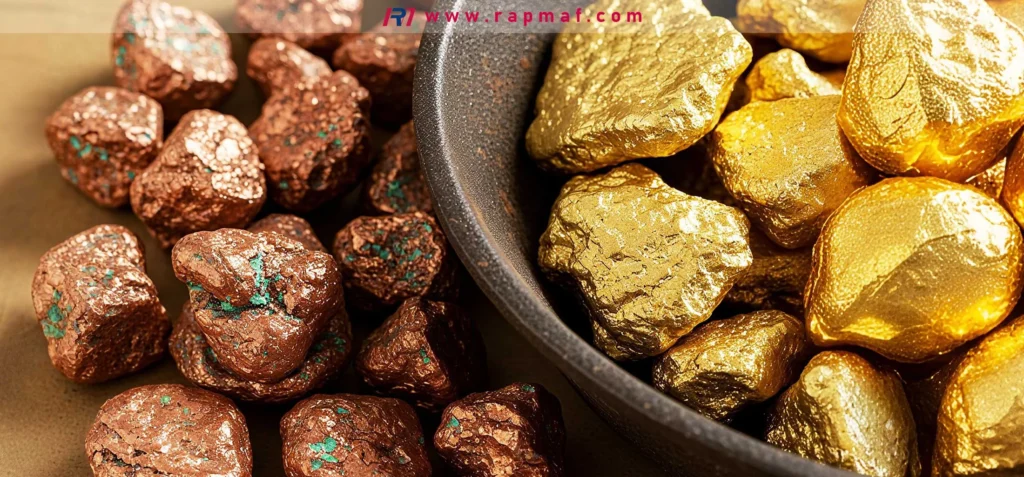
Gold’s melting point is almost identical to copper’s. Both are excellent electrical conductors and are highly malleable and ductile. So why is copper used for house wiring while gold is used for spacecraft electronics?
The Deciding Factor: Corrosion and Cost
The answer lies in a combination of chemistry and economics. Copper, for all its strengths, has an Achilles’ heel: it oxidizes. The patina on a copper roof and the greenish corrosion on old plumbing are evidence of this. For most applications, this isn’t a problem. But in the world of microelectronics, where voltages are tiny and connections are microscopic, even a thin, invisible layer of copper oxide can act as an insulator, causing a complete signal failure.
Gold, on the other hand, is one of the most chemically inert elements. It does not rust, tarnish, or corrode. This makes it the ultimate material for reliability.
- When Gold is Worth It: For mission-critical, low-voltage connections like CPU pins, high-end audio connectors, and the microscopic bond wires inside integrated circuits, gold is the only choice. The cost is astronomical, but the price of failure is even higher.
- When Copper Reigns: For virtually every other electrical application, from the power grid to the phone charger in your wall, copper provides 99% of the performance for a tiny fraction of the cost.
At a Glance: Melting Point Comparison
To put it all into perspective, here is a direct comparison of the key metals we’ve discussed, along with a few others to provide context at the extremes.
| Metal | Melting Point (°C) | Melting Point (°F) | Key Property Trade-Off | Common Application Driven by Thermal Properties |
|---|---|---|---|---|
| Lead | 327.5 °C | 621.5 °F | Very Low Melt Temp / Low Strength | Solder (for joining other metals) |
| Aluminum | 660.3 °C | 1220.5 °F | Low Cost / Good Conductivity | Consumer Heatsinks, Automotive Radiators |
| Gold | 1064.4 °C | 1947.9 °F | Ultimate Reliability / Extreme Cost | Microchip Bond Wires, High-End Connectors |
| Copper | 1084.6 °C | 1984.3 °F | Excellent Conductivity / Good Workability | High-Performance Heatsinks, Electrical Wiring |
| Carbon Steel | ~1425 °C | ~2600 °F | High Strength / Poor Conductivity | Structural Beams, Engine Blocks |
| Tungsten | 3422 °C | 6192 °F | Highest Melt Temp / Very Brittle | Incandescent Bulb Filaments, Rocket Nozzles |
Real-World Case Study: Choosing the Right Material at RM
At our manufacturing facility, a client came to us with a challenge: they needed a compact, highly efficient liquid cooling plate for a series of high-power industrial LEDs. These LEDs generated a massive, concentrated thermal load, and the entire assembly had to fit into a very tight waterproof enclosure.
The Options Analysis:
- CNC Machined Aluminum: This was the cheapest and fastest option. However, our thermal simulations showed that to dissipate the required heat, the aluminum plate would need to be 30% larger than the client’s maximum dimensions. It simply couldn’t move the heat away fast enough.
- Brazed Stainless Steel: We considered a design using thin stainless steel tubes. This would be incredibly durable, but steel’s poor thermal conductivity meant the performance would be even worse than aluminum’s. This option was a non-starter.
- Brazed Copper Assembly: This was the most complex option. We proposed a design using a CNC machined copper baseplate with copper tubes brazed into channels to carry the cooling liquid.
The RM Solution and the Role of Melting Points:
We chose the copper assembly. Here’s why the melting points were the deciding factor:
- Performance: Copper’s high thermal conductivity allowed us to design a cooling plate that fit within the client’s size constraints while exceeding their performance requirements.
- Manufacturing: The key was the joining process. We used a silver-based brazing alloy with a melting point of around 780 °C. This temperature is high enough to create an incredibly strong, durable, and leak-proof bond, but it is still a full 300 °C below the melting point of the copper itself. This gave us a wide, safe processing window to create a perfect joint without any risk of damaging the copper components. Trying to weld steel at
1500°C would have been overkill and risked warping the part, while using low-temperature solder on aluminum (200°C) would not have provided the long-term durability needed for the industrial environment.
The final product was a perfect example of engineering trade-offs. While more expensive than aluminum, the copper assembly was the only option that met the client’s non-negotiable performance and size requirements, a decision made possible by a deep understanding of material properties.
We have now seen how copper’s melting point positions it strategically among other pure metals. But what happens when we intentionally start mixing copper with other metals? In the final part, we will explore the world of copper alloys like brass and bronze, and see how alloying changes the melting point and creates entirely new materials.
Copper’s Most Famous Children: Brass and Bronze
When we start mixing other elements with copper, two legendary alloys immediately come to mind: brass and bronze. These materials have defined entire ages of human history, and they remain critical components in modern manufacturing. One of the most significant changes we create through this alloying process is a modification of the melting point.

Brass: The Workable and Machinable Alloy (Copper + Zinc)
Brass is the generic term for a range of alloys primarily composed of copper and zinc. The addition of zinc has a profound and extremely useful effect: it lowers the melting point.
- Brass Melting Range: ~900 to 940 °C (1650 to 1720 °F)
By adding zinc (which has a low melting point of ~420 °C), the resulting brass alloy melts at a temperature over 140 °C (280 °F) lower than pure copper. This isn’t just a trivial change; it’s a fundamental shift in the material’s manufacturability.
Why a Lower Melting Point is a Huge Advantage:
- Reduced Energy Costs: Heating metal to its melting point is an energy-intensive process. A 140-degree reduction in the required temperature, when scaled up across an industrial foundry, translates to massive savings in energy consumption and cost.
- Improved Castability: Lower melting point alloys tend to be more “fluid” when molten. This improved fluidity allows the material to flow into the tiny, intricate details of a complex mold before it solidifies. This is precisely why brass is the material of choice for applications where complex shapes and a fine surface finish are required.
Common Applications Driven by Brass’s Properties:
- Plumbing Fixtures: The complex curves and internal channels of a faucet are perfectly suited to brass casting.
- Musical Instruments: The precise and elaborate shapes of trumpets, trombones, and saxophones are made possible by brass’s workability.
- Decorative Hardware: Ornate drawer pulls, decorative trim, and high-end light fixtures leverage brass’s easy casting and its desirable golden color.
Bronze: The Strong and Resilient Alloy (Copper + Tin)
Bronze is one of the first alloys ever created by humanity. It is primarily an alloy of copper, usually with tin as the main additive. Like zinc, tin has a very low melting point (~232 °C), and adding it to copper also results in a material with a lower melting range.
- Bronze Melting Range: ~850 to 1000 °C (1560 to 1830 °F)
While also offering improved castability similar to brass, the addition of tin imparts a different set of primary characteristics. Bronze is renowned for its exceptional strength, hardness, and resistance to wear and corrosion, especially in saltwater environments.
Common Applications Driven by Bronze’s Properties:
- Marine Hardware: Propellers, shafts, and fittings on ships are often made from bronze due to its ability to withstand constant exposure to saltwater without significant corrosion.
- Bearings and Bushings: Bronze has excellent “lubricity” and wear resistance, making it an ideal material for sleeves and bearings where metal parts slide against each other.
- Sculptures and Bells: Bronze’s ability to be cast into large, durable shapes with fine detail has made it the preferred material for artists and bell makers for centuries.
Why Alloying Changes the Melting Point: A Simple Analogy
To understand why adding zinc or tin to copper lowers its melting point, we don’t need a degree in metallurgy. Imagine a perfectly stacked wall of identical bricks. Each brick is locked neatly against its neighbors, and the entire structure is stable and strong. To knock the wall down (to “melt” it), you need to apply a significant, specific amount of force. This is like pure copper, with its atoms arranged in a neat, orderly crystal lattice. It takes a precise amount of energy (1084.62 °C) to break these uniform bonds.
Now, imagine building that same wall, but every so often you replace a standard brick with one that is slightly larger or smaller. The wall is still strong, but the neat, perfect structure is gone. The bricks don’t lock together as tightly. There are points of stress and instability. This is an alloy. The zinc or tin atoms are a different size than the copper atoms, and they disrupt the perfect crystal lattice.
Because this new, mixed structure is inherently less stable, it takes less energy (a lower temperature) to break the bonds and get the atoms moving freely as a liquid. This phenomenon, known as “melting-point depression,” is why both brass and bronze melt at lower temperatures than pure copper.
Conclusion: The Melting Point is a Starting Point, Not an Endpoint
We began with a simple question: “What is the melting point of copper?” The answer is a precise, unchanging physical constant: 1084.62 °C (1984.32 °F).
But as we’ve seen, this single number is merely the opening chapter in a much larger story. In the real world of engineering and manufacturing, a material’s value is defined by a complex interplay of properties, processes, and costs.
- Context is Everything: Copper’s melting point places it in a strategic “sweet spot”—more durable and capable than low-temperature metals like aluminum, yet more workable and economical than high-temperature materials like steel.
- Performance is Relative: Compared to gold, copper offers nearly identical thermal and electrical performance at a fraction of the cost, making it the backbone of our electrical infrastructure. The key trade-off is its susceptibility to oxidation, which gold resists completely.
- Alloying is Engineering: The true power of copper is unlocked through alloying. By adding zinc to create brass, we trade a small amount of conductivity for a lower melting point and superior castability. By adding tin to create bronze, we create a material with exceptional strength and wear resistance.
Ultimately, the question isn’t just “What is the melting point?” The real question an engineer asks is, “What is the best possible material to solve this specific problem?” The journey from pure copper to its vast family of alloys shows that sometimes, the best material isn’t one we find, but one we create.
Frequently Asked Questions (FAQs)
1. What is the easiest common metal to melt?
For common, solid metals you might encounter, tin and lead have the lowest melting points, at 232 °C (449 °F) and 327.5 °C (621.5 °F) respectively. This is why they have historically been used for solder. (Mercury is a metal that is liquid at room temperature).
2. What metal has the highest melting point?
Tungsten holds the record for the highest melting point of any metal at an incredible 3422 °C (6192 °F). This is why it was used for the filaments in traditional incandescent light bulbs.
3. Why isn’t pure copper used for casting complex shapes like faucets?
While you can cast pure copper, alloys like brass are far superior for this purpose. Brass is more fluid when molten and has a lower melting temperature, which allows it to fill intricate molds more easily and economically, resulting in a better surface finish and fewer defects.
4. Does alloying a metal always lower its melting point?
For simple binary alloys like brass and bronze, adding a lower-melting-point metal generally depresses the melting point of the mixture. However, in the complex world of metallurgy, this is not a universal rule. Some complex alloy systems can form structures that result in a melting point higher than one or more of the constituent metals. It also changes the melting behavior from a sharp point to a “melting range.”
5. Which is better, copper or brass?
Neither is “better”—they are suited for different jobs. If the absolute highest electrical or thermal conductivity is your primary goal, pure copper is superior. If you need to cast a complex shape, need good machinability, or want a specific golden color, brass is the better choice.
References
- ASM International. (2018). ASM Handbook, Volume 2: Properties and Selection: Nonferrous Alloys and Special-Purpose Materials. (The definitive industry reference for properties of nonferrous alloys, including detailed phase diagrams and melting ranges for hundreds of copper, brass, and bronze formulations).
- Lide, D. R., ed. (2004). CRC Handbook of Chemistry and Physics (85th ed.). CRC Press. (A standard scientific reference for fundamental physical constants, including the precise melting points of pure elements).
- National Institute of Standards and Technology (NIST). (n.d.). Data Gateway – Thermophysical Properties of Fluid Systems. (A public database from a primary standards body providing access to peer-reviewed data on material properties).
Disclaimer
The information on this page is for informational purposes only. RM makes no representations or warranties, express or implied, as to the accuracy or completeness of this information. For any third-party services procured through the RM network, it is the buyer’s responsibility to specify and confirm performance parameters, tolerances, materials, and workmanship during the quotation process. For more detailed information, please do not hesitate to contact us.
RM: Your Precision Manufacturing Partner
RM is an industry leader in custom manufacturing solutions. With over 20 years of profound experience, we have become the trusted partner for more than 5,000 clients worldwide. We specialize in a comprehensive range of manufacturing services—including high-precision CNC machining, sheet metal fabrication, 3D printing, injection molding, and metal stamping—to provide you with a true one-stop-shop experience.
Our world-class facility is equipped with over 100 state-of-the-art 5-axis machining centers and operates in strict compliance with the ISO 9001:2015 quality management system. We are dedicated to providing solutions that blend speed, efficiency, and exceptional quality to customers in over 150 countries. From rapid prototyping to large-scale production, we promise delivery in as fast as 24 hours, helping you gain a competitive edge in the market. Choosing RM means selecting an efficient, reliable, and professional manufacturing ally.
Explore our capabilities today by visiting our website: www.rapmaf.com







14 Responses